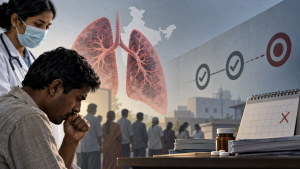
India has missed its ambitious goal to eliminate tuberculosis (TB) by 2025, falling short five years before the global Sustainable Development Goal deadline of 2030. According to the World Health Organization's Global Tuberculosis Report 2026, India saw a 38% reduction in TB deaths between 2015 and 2025, but this was not enough to meet the national target.
Understanding Tuberculosis and India's Challenge
Tuberculosis is a contagious bacterial infection that primarily affects the lungs but can impact other parts of the body. It remains one of the world’s deadliest infectious diseases, especially in countries with dense populations and limited healthcare access. India carries the largest burden of TB globally, accounting for roughly a quarter of all cases and deaths worldwide. The disease’s persistence is linked to factors such as poverty, malnutrition, and inadequate healthcare infrastructure in some regions.
The Indian government set a target to eliminate TB by 2025, aiming to reduce incidence and mortality rates drastically ahead of the global 2030 goal. Elimination means reducing TB cases to very low levels, effectively controlling its spread and impact on public health.
Progress and Key Data from the 2026 WHO Report
- Between 2015 and 2025, TB deaths in India dropped from 28 to 18 per lakh population, a 38% decline.
- This reduction surpassed the WHO End TB Strategy’s 2020 milestone of a 35% decrease but fell short of the 75% reduction target set for 2025.
- India represented about 25% of global TB cases and 23% of TB-related deaths in 2025, maintaining the highest national disease burden.
- The treatment success rate for drug-susceptible TB cases reached 94%, indicating effective management of diagnosed patients.
- India’s latest TB incidence estimates were not included in the report pending review of district-level data, with updates expected in early 2027.
National Efforts Driving TB Control and Screening
The Union Ministry of Health and Family Welfare credits several initiatives under the National Tuberculosis Elimination Programme (NTEP) for the progress made. These include proactive case finding, the use of artificial intelligence-assisted chest X-rays, rapid diagnostic tests, and nutritional support schemes such as Ni-kshay Poshan Yojana and Ni-kshay Mitra.
From December 2024 to November 2026, the TB Mukt Bharat Abhiyaan campaign screened over 250 million people, conducted more than 110 million chest X-rays, and performed over 30 million nucleic acid amplification tests. This large-scale screening effort identified nearly 4.9 million new TB cases, including almost 1.5 million asymptomatic individuals who might otherwise have gone undetected.
Domestic funding covers 96% of the TB programme’s financial needs, reflecting strong national commitment to combating the disease.
Why Missing the 2025 Target Matters for India
Failing to eliminate TB by 2025 highlights the ongoing challenges India faces in controlling this complex disease. Despite impressive strides in reducing mortality and expanding diagnostics, the persistent high burden underscores the need for intensified efforts, especially in rural and underserved areas.
Early detection and treatment are critical to breaking the chain of transmission. The identification of asymptomatic cases through mass screening is a positive development, but sustaining and scaling these efforts will be essential to meet future targets.
Moreover, drug-resistant TB remains a concern, requiring advanced molecular tests like CBNAAT and TruNat to quickly diagnose resistance and guide effective treatment. Strengthening laboratory networks and healthcare infrastructure will be vital to address these challenges.
Frequently Asked Questions
Q: What is tuberculosis and why is it a concern in India?
A: Tuberculosis is a bacterial infection that mainly affects the lungs and spreads through the air. India has the highest number of TB cases globally, making it a major public health challenge due to factors like population density and healthcare access.
Q: What progress has India made in reducing TB deaths?
A: Between 2015 and 2025, India reduced TB deaths by 38%, surpassing the 2020 milestone but not reaching the 2025 target of a 75% reduction.
Q: What strategies has India used to combat TB?
A: India’s National Tuberculosis Elimination Programme uses proactive case finding, AI-assisted X-rays, rapid molecular diagnostics, nutritional support, and large-scale screening campaigns to detect and treat TB cases effectively.