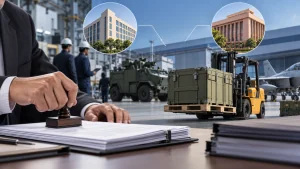
On November 14, 2026, the Ministry of Commerce and Industry announced that the Department for Promotion of Industry and Internal Trade (DPIIT) along with the Department of Commerce (DoC) are authorized to issue industrial licences for defence manufacturing under the Industries (Development and Regulation) Act, 1951. This move clarifies which government bodies oversee licensing for defence production, an important step for manufacturers in this sector.
Understanding Defence Industrial Licensing
Industrial licences are mandatory permits required for manufacturing certain defence equipment classified under compulsory licensing rules. These licences ensure that defence production complies with government regulations and national security standards. The Industries (Development and Regulation) Act, 1951, particularly Section 11, governs the requirement for licences to establish new industrial undertakings in scheduled industries, including defence manufacturing.
The licensing framework distinguishes between manufacturers based on their location and operational status. DPIIT handles licences for defence manufacturers operating outside Special Economic Zones (SEZs), while the Department of Commerce issues licences for those within SEZs and for Export Oriented Units (EOUs). This division streamlines the licensing process and clarifies jurisdiction.
Key Facts About Licensing Authorities and Regulations
- DPIIT's role: Issues licences to defence manufacturers outside SEZs.
- Department of Commerce's role: Issues licences to manufacturers inside SEZs and EOUs.
- Foreign trade oversight: The Department of Commerce’s Directorate General of Foreign Trade manages foreign trade policy and import-export licensing.
- SEZ approvals: Under the SEZ Act, 2005, each zone’s Approval Committee grants unit approvals, separate from the Board of Approval that sanctions SEZs themselves.
- EOU performance criteria: EOUs are evaluated on positive net foreign exchange performance over a five-year period, rather than annually.
Why This Clarification Matters for Defence Manufacturers
By explicitly confirming the licensing authorities, the government provides clarity and certainty to defence manufacturers about where to apply for licences. This reduces confusion and potential delays in obtaining necessary approvals, which can impact production timelines and business planning. For companies operating within SEZs or as EOUs, knowing that the Department of Commerce is the licensing authority helps streamline compliance.
Moreover, the clear division of responsibilities supports the government’s broader goal of promoting defence manufacturing and self-reliance. Efficient licensing processes encourage investment and innovation in the defence sector, which is critical for national security and economic growth.
Frequently Asked Questions
Q: What is an industrial licence for defence manufacturing?
A: It is a mandatory government permit required to manufacture certain defence equipment under the Industries (Development and Regulation) Act, ensuring compliance with regulations and security standards.
Q: Which departments issue these licences?
A: The Department for Promotion of Industry and Internal Trade (DPIIT) issues licences for manufacturers outside Special Economic Zones, while the Department of Commerce handles those within SEZs and Export Oriented Units.
Q: Why is the licensing authority divided between DPIIT and the Department of Commerce?
A: The division is based on the location and operational status of manufacturers to streamline the licensing process and provide clear jurisdiction, reducing confusion and delays.