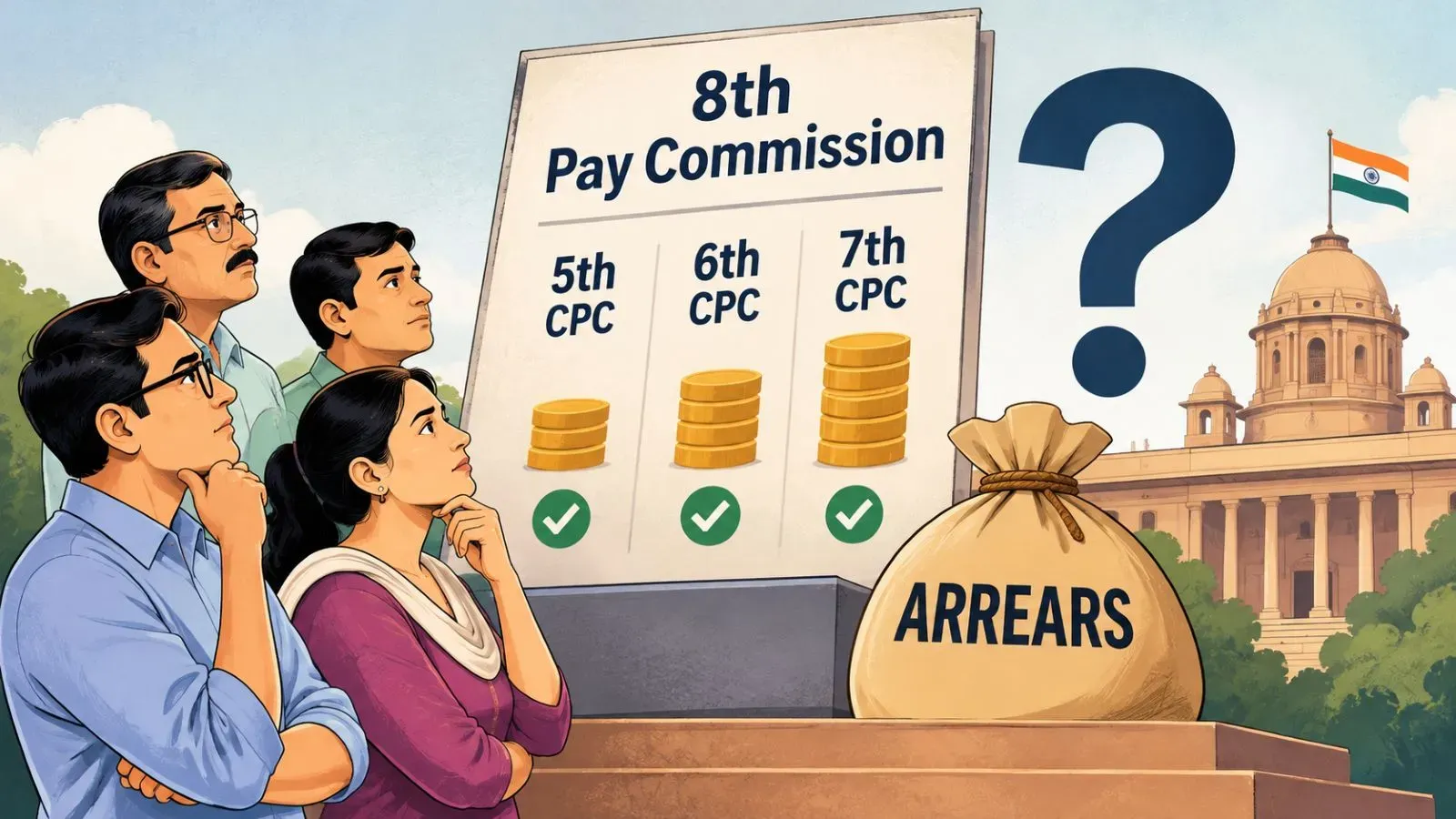
The 8th Pay Commission was set up in November 2025 with a deadline of May 2027 to revise pay scales for central government employees. Many expect arrears to be paid if the new pay is implemented from January 1, 2026. But are arrears guaranteed? This article explains how the 5th, 6th, and 7th Pay Commissions handled arrears and what that might mean for the 8th Pay Commission.
- The 5th Pay Commission paid arrears in two instalments across two financial years.
- The 6th Pay Commission also paid arrears but limited the fiscal impact to 0.77% of GDP.
- The 7th Pay Commission avoided large arrears by setting the effective date at the end of its 10-year cycle.
- The 8th Pay Commission may face arrears if implementation delays occur after January 1, 2026.
How did the 5th Pay Commission handle arrears?
The 5th Pay Commission's award included arrears, which were paid in two parts: the first instalment in 1997-98 and the second in 1998-99. This split payment helped spread out the financial burden. The budget increase was temporary, with government spending returning to normal within three years.
What was the approach of the 6th Pay Commission regarding arrears?
The 6th Pay Commission also included arrears in its award. According to the 7th Pay Commission report, the cumulative effect of arrears from the 5th and 6th Commissions temporarily increased government expenditure, causing a fiscal shock. To manage this, the 7th CPC set a ceiling, stating that any macroeconomic impact exceeding 0.77% of GDP would not be fiscally prudent. This limit helped control government spending and inflation risks.
How did the 7th Pay Commission avoid arrears?
The 7th Pay Commission took a different approach by setting the date of effect at January 1, 2016, which was the end of its 10-year cycle. This timing meant the new pay scales were implemented on time, resulting in only marginal arrears. The commission explicitly rejected demands for earlier implementation and retrospective pay hikes, emphasizing fiscal prudence. The fitment factor of 2.57 included merging basic pay with dearness allowance, reducing the need for arrears.
What options exist if arrears arise?
The 7th Pay Commission report noted that governments have used various methods to manage arrears, such as:
- Choosing a different date of implementation than the central government.
- Staggering arrears payments over time.
What challenges does the 8th Pay Commission face?
The 8th Pay Commission's deadline is May 2027, with a proposed effective date of January 1, 2026. If the award is implemented after May 2027, arrears will accumulate for the period between these dates. Unlike the 7th CPC, which avoided arrears by aligning dates, the 8th CPC may not be able to do so. It could follow the 5th CPC model of spreading arrears payments or the 6th CPC's fiscal limit of 0.77% of GDP. Alternatively, it might align the effective date with implementation to avoid arrears, but this remains uncertain.
In summary, arrears are not guaranteed with the 8th Pay Commission. Past pay commissions offer two main templates: spreading arrears payments or limiting fiscal impact. The 7th Pay Commission's strategy of aligning dates successfully minimized arrears, but the 8th Pay Commission's approach will depend on its implementation timing and fiscal considerations.