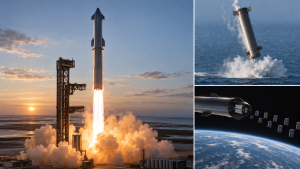
On November 13, 2026, SpaceX launched its 15th Starship test flight, known as Flight 15, from its Starbase facility in Texas. While the mission successfully placed the Starship upper stage into low Earth orbit, the Super Heavy booster, designated Booster 22, experienced a malfunction during its return and exploded after an offshore splashdown in the Gulf of Mexico. This failure prevented the booster from being caught by the launch tower’s mechanical arms, called "chopsticks," which are designed to recover the booster intact.
Despite the loss of the booster, the upper stage of Starship, Ship 42, continued its mission and reached an altitude of approximately 275 kilometers. From orbit, it deployed 26 Starlink V3 satellites, marking Starship’s first operational payload delivery and its second orbital flight following Flight 14 in September.
Understanding Starship and Its Components
Starship is SpaceX’s next-generation spacecraft designed for missions ranging from satellite deployment to crewed flights to the Moon and Mars. The system consists of two main parts: the Super Heavy booster and the Starship upper stage. The booster provides the initial thrust to escape Earth’s atmosphere, while the upper stage carries payloads into orbit or beyond.
The Super Heavy booster is equipped with multiple Raptor engines, which use a full-flow staged-combustion cycle for efficient performance. Starship’s upper stage, Ship 42 in this flight, features vacuum-optimized engines tailored for space conditions. Recovery of both stages is a critical part of SpaceX’s plan to make spaceflight more sustainable and cost-effective.
Key Facts from Flight 15
- The flight launched from Starbase, Texas, on November 13, 2026.
- Booster 22 malfunctioned during descent and was diverted to a splashdown in the Gulf of Mexico, where it exploded.
- The booster’s failure prevented the planned catch by the launch tower’s mechanical arms.
- Ship 42 reached low Earth orbit at about 275 kilometers altitude.
- 26 Starlink V3 satellites were successfully deployed from orbit.
- The orbital flight was planned to last about 22 hours, completing 14 to 15 orbits.
- SpaceX planned to attempt recovery of Ship 42 at Starbase on November 14, aiming for the first orbital Starship upper stage recovery.
- Starship uses a hot-staging separation method where the upper stage engines ignite before separation, protected by a vented interstage.
What This Flight Means for SpaceX’s Starship Program
This flight demonstrated Starship’s growing capabilities despite the setback with the booster. Successfully reaching orbit and deploying operational satellites is a major step forward, showing that Starship can carry out complex missions beyond test flights. Recovering the upper stage intact would further validate SpaceX’s reusable spacecraft approach, potentially reducing launch costs significantly.
The booster explosion highlights ongoing challenges with the Super Heavy’s return and recovery systems. Catching the booster with mechanical arms is a novel technique aimed at rapid turnaround times, but it remains a difficult maneuver. SpaceX will likely analyze the failure to improve booster reliability and recovery methods in future flights.
Overall, Flight 15 confirms that Starship is moving closer to becoming a fully operational launch vehicle capable of supporting a wide range of missions, from satellite deployment to deep space exploration.
Frequently Asked Questions
Q: What caused the Super Heavy booster to explode?
A: Booster 22 malfunctioned during its return to Earth and was diverted to an offshore splashdown where it exploded. The exact technical cause has not been detailed, but it prevented the booster from being caught by the launch tower’s mechanical arms.
Q: What payload did Starship carry on this flight?
A: The Starship upper stage, Ship 42, deployed 26 Starlink V3 satellites into low Earth orbit, marking its first operational payload delivery.
Q: Why is recovering the Starship upper stage important?
A: Recovering the upper stage would demonstrate SpaceX’s ability to reuse the entire Starship system, reducing launch costs and increasing the frequency of missions.