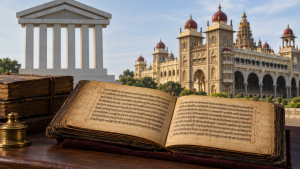
On November 5, 2026, UNESCO officially recognized a rare manuscript of Kautilya’s Arthashastra, preserved at the Oriental Research Institute (ORI) in Mysuru, India. This manuscript was added to the Memory of the World Committee for Asia and the Pacific (MOWCAP) Regional Register, marking a significant milestone in the preservation of ancient Indian heritage.
The Arthashastra is a foundational text on governance, administration, and statecraft, written by the ancient scholar Kautilya, also known as Chanakya. The manuscript recognized by UNESCO is a 16th-century palm-leaf copy, discovered over a century ago in 1905 by Rudrapatnam Shamasastry, a scholar and librarian at the University of Mysore.
The Historical Significance of the Arthashastra Manuscript
The Arthashastra is one of the oldest treatises on political science and economics, offering detailed insights into the workings of a state, including law, diplomacy, military strategy, and administration. Its teachings have influenced Indian political thought for centuries. The manuscript preserved at ORI is particularly valuable because it provides a direct link to this ancient knowledge through its original palm-leaf format.
Alongside the Arthashastra, other important manuscripts such as the Mahabharata and Kalhana’s Rajatarangini were also added to the MOWCAP Regional Register on the same day, bringing India’s total entries to six. This recognition helps safeguard these cultural treasures and promotes their study and appreciation worldwide.
Preservation Efforts and Manuscript Care at Mysuru
The Oriental Research Institute has played a crucial role in preserving this manuscript for over a century. The institute uses traditional and modern techniques to maintain the delicate palm leaves. For instance, lemongrass oil is applied to the leaves to act as a natural pesticide, restore their flexibility, and protect them from humidity-related damage.
In addition to physical preservation, ORI has digitized the manuscript to ensure its longevity and wider accessibility. Advanced software tools help reconstruct fragmented sections and fill in missing text, allowing scholars to study the text in greater detail without risking damage to the original material.
Why UNESCO Recognition Matters for Indian Heritage
UNESCO’s inclusion of the Arthashastra manuscript in the Memory of the World Register highlights the global importance of India’s ancient texts. This recognition not only raises awareness about the manuscript’s historical and cultural value but also encourages further research and conservation efforts.
The Arthashastra’s detailed exploration of governance through its 15 books and the saptanga theory—which describes the seven essential elements of a state—continues to be relevant for understanding political systems today. By preserving and promoting such manuscripts, institutions like ORI help keep India’s rich intellectual traditions alive for future generations.
Frequently Asked Questions
Q: What is the Arthashastra?
A: The Arthashastra is an ancient Indian treatise on governance, economics, and military strategy, traditionally attributed to the scholar Kautilya (Chanakya).
Q: How old is the manuscript recognized by UNESCO?
A: The manuscript is a 16th-century palm-leaf copy discovered in 1905 at the Oriental Research Institute in Mysuru.
Q: What preservation methods are used for the palm-leaf manuscript?
A: The Oriental Research Institute applies lemongrass oil to protect the leaves from pests and humidity, and uses digital restoration techniques to repair and preserve the text.