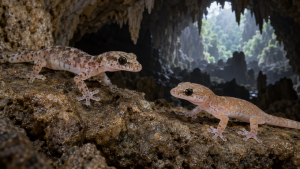
Two previously unknown species of cave-dwelling bent-toed geckos, named Cyrtodactylus bossmit and Cyrtodactylus kremicola, were formally described on 25 November 2026 in the scientific journal Taprobanica. These discoveries were made by a team of researchers from Assam Don Bosco University, Cotton University, and the biodiversity organisation Help Earth. The geckos were found in Meghalaya’s Khasi and Jaintia Hills, a region known for its rich biodiversity and extensive cave systems.
"The discovery of these two species highlights the unique and fragile ecosystems present in Meghalaya's caves," said one of the lead researchers. "Each species plays a vital role in maintaining the ecological balance within these subterranean habitats."
Distinctive Habitats and Naming Origins
Cyrtodactylus bossmit, commonly called the Bossmit bent-toed gecko, was discovered at Maw Tynghiang Cave in Nongnah village, located in the South West Khasi Hills district. This species has also been recorded at other sites within the Khasi Hills. The name 'bossmit' pays homage to the traditional wooden buses of Shillong, locally known as Bossmit, symbolising a cultural connection to the region.
The second species, Cyrtodactylus kremicola, or Krem bent-toed gecko, was found exclusively at Rupasor Cave in Syndai village, West Jaintia Hills district. Its name combines the Khasi word "Krem," meaning cave, with the Latin "cola," meaning inhabitant, reflecting its cave-dwelling nature. Currently, this species is known only from this specific locality, underscoring its potentially limited distribution and the importance of habitat conservation.
Scientific Analysis and Taxonomic Clarifications
The identification of these new species involved detailed morphological studies paired with molecular genetic analyses. These methods allowed researchers to differentiate the new geckos from closely related populations with precision. The study also resolved a longstanding taxonomic question regarding Cyrtodactylus khasiensis, a species first described in 1870 but lacking genetic validation until now. The team established the first genetically validated reference specimen from Arwah Cave in East Khasi Hills, providing clarity on this species' classification.
With these additions, the total number of known bent-toed gecko species in Meghalaya rises to nine, highlighting the region's status as a hotspot for reptilian diversity.
Ecological and Biological Insights
Bent-toed geckos of the genus Cyrtodactylus differ from many other geckos by lacking broad adhesive toe pads. Instead, they possess slender, curved digits with rows of scales beneath the toes, adaptations that suit their cave-dwelling lifestyle. However, the presence of these geckos in caves does not necessarily mean they are obligate cave dwellers. Scientists distinguish between troglobites, species that depend entirely on subterranean habitats, and troglophiles, which can survive both inside and outside caves. Further ecological studies are needed to determine the exact cave-dependence of these new species.
These findings underscore the importance of Meghalaya’s cave ecosystems and the need to protect them from environmental threats such as habitat destruction and pollution. The discovery of Cyrtodactylus bossmit and Cyrtodactylus kremicola adds valuable knowledge to the biodiversity of the region and provides new opportunities for research on cave-adapted fauna.