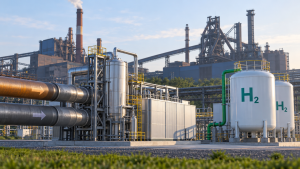
On November 18, 2026, Tata Steel announced a collaboration with Houston-based Utility Global to develop a pioneering hydrogen production facility at its Kalinganagar plant in Odisha. This project aims to produce 10 tonnes of high-purity hydrogen daily by utilizing gases emitted from the steel manufacturing process, marking the first such initiative in India.
Hydrogen Production from Steel Plant Gases
The proposed facility will harness Utility Global’s H2Gen technology, an innovative electrochemical method that extracts hydrogen from carbon monoxide-rich gases generated during steel production. These gases include blast furnace gas and basic oxygen furnace gas, by-products typically released in steelmaking. The technology has been successfully tested at a steel plant in Canada, demonstrating its viability for industrial use.
Currently, Tata Steel and Utility Global are conducting detailed Front-End Engineering and Design (FEED) studies to finalize the project’s scope and costs. The final investment decision will be made by Tata Steel’s board based on these studies. If approved, the plant will become Utility Global’s largest industrial deployment of H2Gen technology and its first project in India.
Understanding the Technology and Its Context
Blast furnace gas is generated when iron ore is reduced with coke to produce metallic iron. This gas contains a mix of carbon monoxide, hydrogen, nitrogen, and carbon dioxide. While nitrogen and carbon dioxide are non-flammable, the carbon monoxide and hydrogen components can be converted into hydrogen fuel through electrochemical processes.
Electrochemical electron transfer, the core of H2Gen technology, involves moving electrons through a conductive material between electrodes, enabling the separation of hydrogen from other gases without combustion. This method offers a cleaner alternative to traditional hydrogen production techniques, which often rely on fossil fuels.
Why Tata Steel’s Hydrogen Facility Matters
This project is a key part of Tata Steel’s broader strategy to reduce carbon emissions and transition toward low-carbon steelmaking. The company has committed to achieving net-zero emissions by 2045, and utilizing existing steel plant gases to produce hydrogen supports this goal by turning waste gases into valuable clean energy.
Subodh Pandey, Tata Steel’s vice-president, highlighted that the H2Gen technology could significantly cut emissions by leveraging the steel plant’s current infrastructure, avoiding the need for entirely new systems. This approach not only advances sustainability but also demonstrates how traditional heavy industries can innovate to meet climate targets.
Frequently Asked Questions
Q: What is blast furnace gas?
A: Blast furnace gas is a by-product generated during the process of reducing iron ore with coke to produce metallic iron. It contains carbon monoxide, hydrogen, nitrogen, and carbon dioxide.
Q: How does H2Gen technology produce hydrogen?
A: H2Gen uses an electrochemical process that transfers electrons through conductive materials to separate hydrogen from carbon monoxide-rich gases without burning them.
Q: Why is this hydrogen facility important for Tata Steel?
A: The facility helps Tata Steel reduce its carbon footprint by converting waste gases into clean hydrogen fuel, supporting its goal of net-zero emissions by 2045.