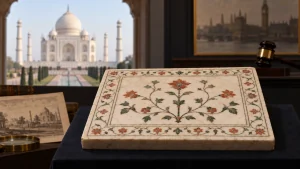
A marble slab believed to be associated with the Taj Mahal is set for auction in London on December 9, 2026. The slab, featuring floral designs inlaid with semi-precious stones, will be offered by Lyon & Turnbull in their Islamic and Indian Art sale, carrying an estimated price between £20,000 and £30,000 (approximately Rs 24 lakh to Rs 36 lakh).
This rectangular marble piece measures 55.8 cm by 45.2 cm by 3 cm and is bordered with a pattern closely resembling the intricate designs on Shah Jahan’s cenotaph inside the Taj Mahal. The slab's provenance traces back to 1816 when Colonel Pownoll Phipps, an officer of the East India Company and superintendent of repairs in Agra, discovered it. According to memoirs written by Phipps’s son, the slab was found in a "souterrain," or underground chamber, at the monument and was believed to have been intended for repair work. Phipps collected two such slabs during his tenure, and this particular piece has remained in his family for over two centuries.
Alongside the slab, the auction includes a vintage photograph of the Taj Mahal and two letters: one printed by Phipps’s grandson and another handwritten by the Marquess of Bath, adding historical context and authentication to the artifact.
Historical Significance of the Marble Slab
The slab exemplifies the Mughal pietra dura technique, locally known as parchin kari, which involves inlaying semi-precious stones into marble to create floral and geometric patterns. This art form is one of the defining features of the Taj Mahal’s exquisite decoration. The floral border on the slab closely mirrors the patterns found on Shah Jahan’s cenotaph, which sits in the main chamber of the mausoleum.
It’s important to note that the cenotaphs inside the Taj Mahal are commemorative markers; the actual tombs of Shah Jahan and Mumtaz Mahal lie in a crypt beneath the main chamber. The slab’s discovery in an underground area suggests it may have been part of repair or restoration efforts during the early 19th century, a period when the monument underwent maintenance under British supervision.
Mughal Architecture and Conservation Context
The Taj Mahal’s mausoleum is uniquely positioned at the northern end of its charbagh garden, adjacent to the Yamuna river, rather than at the garden’s center. This design choice reflects the monument’s symbolic and aesthetic considerations. Additionally, the monument’s inscriptions are crafted with optical precision: Qur’anic verses on the gateway increase in letter size higher up to appear uniform when viewed from below.
Colonel Pownoll Phipps’s role as superintendent of repairs highlights early British involvement in the monument’s upkeep. His collection of architectural fragments like this slab provides valuable insight into the conservation history of the Taj Mahal. The slab’s auction raises questions about the stewardship of such artifacts and their place in public heritage.
As the auction date approaches, the marble slab offers a tangible connection to the Taj Mahal’s rich history and craftsmanship, inviting renewed interest in the monument’s preservation and the stories embedded in its stones.