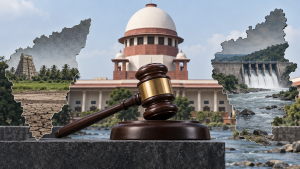
On November 20, 2026, India’s Supreme Court dismissed two petitions filed by Tamil Nadu seeking an order for Karnataka to release approximately 11 thousand million cubic feet (TMC) of Cauvery river water. The request came amid ongoing disputes over water sharing between the two states, with Tamil Nadu alleging a significant shortfall in water delivery.
Background of the Cauvery Water Dispute
The Cauvery river has long been a source of conflict between Karnataka and Tamil Nadu, two southern Indian states that rely heavily on its waters for agriculture, drinking supply, and industry. The dispute dates back decades, with multiple tribunals and court rulings attempting to regulate water sharing. In 1991, the Cauvery Water Disputes Tribunal issued an interim award mandating Karnataka to release 205 TMC annually to Tamil Nadu according to a fixed monthly schedule.
In 2018, the Supreme Court revised this allocation, increasing Karnataka’s share by 14.75 TMC and reducing Tamil Nadu’s share by the same amount. To oversee the implementation of these rulings, the central government established the Cauvery Water Management Authority and its technical wing, the Cauvery Water Regulation Committee, in 2018. These bodies are responsible for monitoring and ensuring compliance with the water-sharing agreements.
Details of the Supreme Court’s Recent Decision
- The Supreme Court bench, led by Justices Vikram Nath and Aparesh Kumar Singh, rejected Tamil Nadu’s applications seeking the release of 1.3 TMC per day for 10 days at Billigundulu, a measuring station on the Karnataka-Tamil Nadu border.
- Tamil Nadu claimed a shortfall of about 11.7 TMC in water delivery through early October 2026, with some reports citing an 11 TMC backlog as of October 7.
- Karnataka opposed the release, citing drought conditions affecting several districts and arguing that the existing water-sharing framework did not require further court intervention.
- The Supreme Court had reserved its judgment on these applications since October 12, 2026, before delivering the dismissal on November 20.
- There was some uncertainty regarding a third application filed by Tamil Nadu, with reports indicating either a likely dismissal or an adjournment.
Why the Supreme Court’s Ruling Matters
This ruling highlights the delicate balance between legal mandates and ground realities such as drought and water scarcity. Karnataka’s resistance to releasing additional water reflects the severe challenges faced by farmers and residents during dry spells. Tamil Nadu’s insistence on receiving its full share underscores the dependence of its agricultural economy on Cauvery waters.
The Supreme Court’s decision also reaffirms the authority of the Cauvery Water Management Authority and the existing legal framework governing inter-state water disputes. By declining to intervene further, the court signals that states must work within established mechanisms rather than seeking ad hoc judicial relief. This approach aims to promote long-term cooperation and prevent escalation of conflicts over water resources.
As water scarcity intensifies due to climate change and population growth, disputes like the Cauvery case will remain critical. The ruling serves as a reminder of the need for sustainable water management policies and collaborative solutions among states sharing river basins.
Frequently Asked Questions
Q: What is the Cauvery Water Disputes Tribunal?
A: It is a tribunal established in 1990 to adjudicate the water-sharing dispute between Karnataka, Tamil Nadu, Kerala, and Puducherry over the Cauvery river. It issued interim and final awards on water allocation.
Q: Why did Tamil Nadu seek 11 TMC of water from Karnataka?
A: Tamil Nadu claimed that Karnataka had not released the agreed amount of Cauvery water, leading to a backlog of about 11 TMC, which Tamil Nadu wanted Karnataka to release immediately to meet its water needs.
Q: What role does the Cauvery Water Management Authority play?
A: Established in 2018, this authority oversees the implementation of the water-sharing agreements between states, monitors water releases, and resolves disputes to ensure compliance with court and tribunal orders.