A recent study conducted by the Wildlife Institute of India (WII) has documented 26 bird species living at elevations above their previously known upper limits in the Gangotri landscape of Uttarakhand. The research, published on November 19, 2026, in the journal Environmental Monitoring and Assessment, analyzed 551 confirmed sightings of 55 bird species recorded between 2016 and 2018.
Exploring Bird Elevation Limits in the Himalayas
Bird species are typically found within certain elevation ranges that suit their habitat and survival needs. These ranges are often well documented in scientific literature and conservation databases. However, the rugged terrain and remote nature of the Himalayas mean that some species’ true elevation limits may be underreported. The Gangotri region, part of the Bhagirathi river basin and including Gangotri National Park and adjacent forest areas, spans elevations from 2,500 to 5,250 meters, providing a challenging environment for wildlife surveys.
Understanding where birds live at high altitudes is important for tracking the effects of climate change and habitat shifts. Birds moving to higher elevations could indicate changing environmental conditions, but confirming such shifts requires detailed and repeated observations.
Key Findings from Camera-Trap Data
- The study used 228 camera-trap stations placed across the Gangotri landscape, primarily aimed at monitoring large mammals and ground-dwelling birds like Galliformes.
- Despite this focus, researchers recorded incidental sightings of 26 bird species above their known elevation limits, totaling 137 such records.
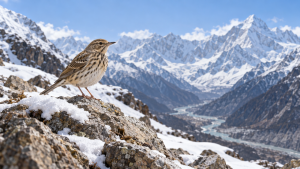
- Fourteen species were detected repeatedly at multiple stations, including notable birds like the Himalayan Monal, Snow Pigeon, Olive-backed Pipit, Tibetan Snowfinch, and Himalayan Snowcock.
- The Red-wattled Lapwing was observed at an elevation 3,286 meters higher than previously recorded, while the Brahminy Starling was found 2,466 meters above its known range.
- Some birds were detected far beyond their mapped geographic ranges according to the International Union for Conservation of Nature (IUCN), with the Tibetan Snowfinch recorded more than 1,250 kilometers outside its known area.
Interpreting the Results and Their Significance
While these findings are intriguing, the researchers caution against drawing immediate conclusions about climate-driven range shifts. The camera traps were not specifically designed to study birds, and many detections were incidental. Small birds, in particular, may not trigger the sensors reliably, so absence of evidence is not evidence of absence.
WII project scientist Vineet Dubey emphasized the need for longer-term and broader surveys to confirm whether these elevation exceedances represent true changes in bird distribution or simply gaps in previous data. Additionally, the study highlights that broad-scale maps and published elevation limits may not fully capture local variations in species presence, especially in complex mountain landscapes.
These insights contribute to a better understanding of Himalayan biodiversity and underscore the importance of continuous monitoring to detect ecological changes in sensitive mountain ecosystems.
Frequently Asked Questions
Q: How were the birds detected at such high elevations?
A: Researchers used camera traps equipped with motion sensors placed across the Gangotri region. Although primarily set up to monitor mammals and ground birds, these cameras also captured images of other bird species.
Q: Does this study prove that birds are moving higher due to climate change?
A: No, the study does not confirm climate-driven range shifts. The researchers suggest that more extensive and repeated surveys are needed to determine if these observations indicate real changes in bird distribution.
Q: What challenges exist in studying birds at high altitudes?
A: High-altitude environments are difficult to access and survey. Camera traps may miss small birds, and existing range maps may not reflect local variations, making it challenging to establish accurate elevation limits for many species.