On November 18, 2026, Hyderabad-based Skyroot Aerospace announced a collaboration with three other companies for the second planned orbital flight of its Vikram-1 launch vehicle. The announcement took place at the Space Tech Expo Europe 2026 in Bremen, Germany. This partnership brings together expertise in launch vehicles, satellite technology, deployment systems, and in-space propulsion to support the mission.
Understanding the Vikram-1 Mission and Partners
Skyroot Aerospace is an Indian private space company that developed the Vikram-1 rocket, which successfully completed its maiden orbital flight on July 18, 2026, from the Satish Dhawan Space Centre in Sriharikota. The Vikram-1 is designed to carry small satellites into orbit, marking a significant step for India’s private space sector under the country’s 2023 Space Policy, which encourages private entities to develop and operate space missions.
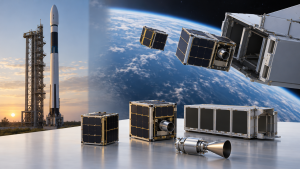
For this second flight, Skyroot will provide the Vikram-1 launch vehicle along with its own 4U SCOPE satellite. HEX20, a company based in Thiruvananthapuram, will contribute its 4U NILA III satellite. Exolaunch, a German company specializing in satellite deployment, will supply an 8U deployer system to release both satellites once in orbit. OhmSpace, an Italian firm, will provide a high-temperature resistojet propulsion system installed on the NILA III satellite for an in-orbit technology demonstration.
Key Details About the Flight and Payloads
- The Vikram-1 rocket’s first orbital flight was confirmed successful by the Indian Space Research Organisation (ISRO) on July 18, 2026.
- The second flight date has not yet been announced; the current announcement pertains to the planned mission.
- HEX20’s NILA III satellite was initially scheduled for launch on a SpaceX Transporter mission via Exolaunch but was later shifted to the Vikram-1 flight.
- Exolaunch’s role as a launch integrator involves coordinating payload compatibility, interface documentation, and deployment logistics, distinct from the launch operator’s role.
- The high-temperature resistojet on NILA III electrically heats propellant to increase thrust efficiency, offering better performance than traditional cold-gas thrusters.
- Integration of the payloads and deployment system was completed within two months of initial discussions between the partners.
Why This Partnership Is Significant for India’s Space Sector
This collaboration highlights the growing role of private companies in India’s space industry, enabled by the 2023 Space Policy that allows non-government entities to develop launch vehicles and conduct space missions. Skyroot’s Vikram-1 rocket represents a milestone as India’s first privately developed orbital-class launch vehicle. The involvement of international partners like Exolaunch and OhmSpace demonstrates increasing global cooperation in space technology.
The inclusion of advanced propulsion technology such as the resistojet on the NILA III satellite also marks progress in in-space propulsion capabilities, which are crucial for satellite maneuvering and mission flexibility. Successful deployment and operation of these payloads will further validate the capabilities of private Indian space firms and encourage more innovation and investment in the sector.
Frequently Asked Questions
Q: What is the Vikram-1 launch vehicle?
A: Vikram-1 is India’s first privately developed orbital-class rocket by Skyroot Aerospace, designed to carry small satellites into low Earth orbit.
Q: What role does Exolaunch play in the mission?
A: Exolaunch acts as the launch integrator, managing payload compatibility and deployment systems to ensure satellites are safely released into orbit.
Q: What is a resistojet and why is it important?
A: A resistojet is a propulsion system that electrically heats propellant to increase thrust efficiency, providing better performance than cold-gas thrusters for satellite maneuvering in space.