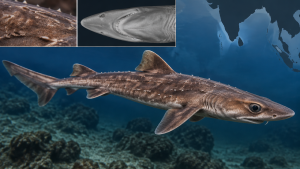
On November 12, 2026, scientists from the Zoological Survey of India and the ICAR-Central Marine Fisheries Research Institute officially recognized the Indian Bramble Shark, scientifically named Echinorhinus roinee, as a new species. Previously mistaken for the Atlantic bramble shark, this discovery sheds light on the diversity of deep-sea sharks in Indian waters.
How the Indian Bramble Shark Was Discovered
The identification came after specimens were accidentally caught by deep-sea shrimp trawlers operating near the Sakthikulangara Fishing Harbour in Kollam, Kerala. These sharks inhabit the continental slope at depths ranging from 350 to 450 meters. Measuring up to three meters in length, the Indian Bramble Shark stands out due to its larger eyes and pelvic fins, as well as a longer distance between its snout and gill openings compared to related species.
Scientific Evidence Behind the Classification
Researchers conducted detailed DNA analysis to differentiate Echinorhinus roinee from its close relatives, the Atlantic bramble shark (Echinorhinus brucus) and the Pacific prickly shark (Echinorhinus cookei). Genetic data also suggest that this species may inhabit waters beyond India, including regions near Oman, Sri Lanka, and Thailand. The findings were published in the 2026 volume of the Records of the Zoological Survey of India. The species name honors Roinee, the daughter of Dhriti Banerjee, Director of the Zoological Survey of India. This research was supported by the Ministry of Earth Sciences as part of India’s Deep Ocean Mission.
Why Identifying This Shark Matters for Marine Science
Recognizing the Indian Bramble Shark as a distinct species is significant for several reasons. It improves our understanding of marine biodiversity, especially in deep-sea ecosystems that remain largely unexplored. Accurate species identification is crucial for conservation efforts, as it helps assess the health of marine populations and informs sustainable fishing practices. Additionally, this discovery highlights the value of combining traditional morphological studies with modern genetic techniques to clarify species classification.
- The Zoological Survey of India maintains extensive collections inherited from historic institutions, aiding taxonomic research.
- The ICAR-Central Marine Fisheries Research Institute focuses on marine organism taxonomy and the biology of commercially important fish and shellfish.
- DNA barcoding, which compares mitochondrial gene sequences, supports but does not replace traditional species identification methods.
- International rules require that new species names be linked to physical type specimens held in recognized collections.
Frequently Asked Questions
Q: What distinguishes the Indian Bramble Shark from other bramble sharks?
A: It has larger eyes and pelvic fins, a longer snout-to-gill distance, and genetic differences that set it apart from the Atlantic and Pacific bramble sharks.
Q: Where was the Indian Bramble Shark discovered?
A: Specimens were collected off the coast of Kerala, India, near the Sakthikulangara Fishing Harbour, at depths of 350 to 450 meters.
Q: How does this discovery impact marine conservation?
A: Identifying new species helps scientists better understand marine biodiversity and supports efforts to protect deep-sea ecosystems and manage fisheries sustainably.