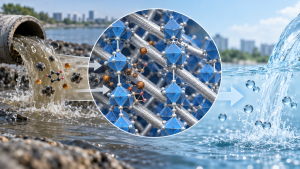
Scientists at the Institute of Advanced Study in Science and Technology (IASST) in Guwahati have engineered a novel material that harnesses sunlight to break down harmful pollutants in water. This new hybrid combines metallic nanowires with a metal-organic framework (MOF) to target and remove toxic compounds such as pyrene, a persistent pollutant known for its environmental and health risks.
The breakthrough was announced on November 23, 2026, marking a significant step forward in pollution remediation technologies that rely on renewable energy sources.
Understanding Metal-Organic Frameworks and Nanowires
Metal-organic frameworks are crystalline materials made by linking metal ions or clusters with organic molecules to create porous structures. These pores can be engineered to trap or interact with specific molecules, making MOFs highly versatile for applications like gas storage, catalysis, and pollutant removal.
Nanowires are ultra-thin wires, often only a few nanometers wide, that exhibit unique electrical and optical properties due to quantum confinement effects. When integrated into MOFs, nanowires can enhance the material's ability to absorb light and catalyze chemical reactions.
In this study, copper nanowires were embedded within a specific MOF known as isoreticular metal-organic framework-8 (IRMOF-8). This combination creates a hybrid material capable of efficiently harnessing sunlight to degrade pollutants.
Key Details of the Pollutant Removal Process
- The hybrid material integrates copper nanowires confined inside IRMOF-8, creating a porous, light-responsive structure.
- Palladium nanostructures were added to improve light absorption and boost photocatalytic activity, achieving 99% removal of pyrene under sunlight.
- Aluminium was tested as a more affordable alternative to palladium, reaching 85% pollutant removal under similar conditions.
- Pyrene is a toxic polycyclic aromatic hydrocarbon (PAH) known for its persistence in the environment and difficulty to break down.
- The process uses sunlight and ultrasonication to activate the material, enhancing degradation efficiency.
- The research was led by Professor Devasish Chowdhury and PhD scholar Netra Prova Baruah and published in the journal ACS Applied Energy Materials.
Why This Development Matters for Environmental Cleanup
Pyrene and other PAHs are common pollutants resulting from incomplete combustion of organic matter, often found in industrial waste and urban runoff. Their persistence and toxicity pose serious risks to ecosystems and human health. Traditional remediation methods can be costly, inefficient, or environmentally harmful.
The new nanowire-integrated MOF offers a sustainable alternative by using sunlight—a free and abundant energy source—to drive the breakdown of these pollutants. The high removal efficiency demonstrated, especially with palladium-enhanced materials, shows promise for practical water treatment applications.
Moreover, exploring aluminium as a lower-cost substitute could make this technology more accessible for widespread use, particularly in resource-limited settings. This innovation aligns with global efforts to develop greener, more effective pollution control strategies.
Frequently Asked Questions
Q: What is a metal-organic framework (MOF)?
A: A MOF is a porous material made by connecting metal ions with organic molecules, creating a structure that can trap or interact with specific substances, useful in filtering and catalysis.
Q: Why is pyrene difficult to remove from the environment?
A: Pyrene is a stable polycyclic aromatic hydrocarbon that resists natural degradation processes, making it persistent and toxic in soil and water.
Q: How does integrating nanowires improve pollutant removal?
A: Nanowires enhance light absorption and catalytic activity within the MOF, enabling more efficient use of sunlight to break down pollutants like pyrene.