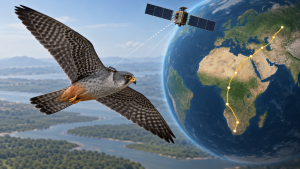
On November 21, 2026, a young female Amur falcon called Alang completed an extraordinary nonstop flight from Manipur, India, to Somalia, covering 5,700 kilometers in just over four days. Weighing only about 150 grams, Alang crossed the vast Arabian Sea without pausing to rest or feed, a feat recorded through satellite tracking technology.
Tracking the Amur Falcon’s Migration
The Wildlife Institute of India equipped Alang and another falcon named Apapang, an adult male, with lightweight satellite transmitters in November 2025 as part of the Manipur Amur Falcon Tracking Project. These devices allowed researchers to monitor their precise routes and flight durations during migration. Apapang was tracked flying over the Arabian Sea after covering 4,100 kilometers in 95 hours and reached Somalia by November 23, completing a nonstop flight of approximately 5,400 kilometers.
The falcons began their ocean crossing from a roosting site in Tamenglong district, following nearly 25 days of feeding and resting in Manipur and Nagaland. Their diet mainly consists of insects such as termites, which they consume in large numbers before embarking on their long journey. The Amur falcon’s annual migration stretches from breeding grounds in eastern Russia, northeastern China, and Mongolia to wintering areas in southern and eastern Africa, passing through northeastern India on the way.
Key Facts About the Amur Falcon’s Journey
- Wind Assistance: The falcons benefit from strong westward winds at altitudes around 3,000 meters, which help them glide efficiently while migrating above 1,000 meters.
- Food During Flight: Their crossing of the Arabian Sea coincides with the migration of dragonflies, which likely serve as a vital food source during this demanding stretch.
- Seasonal Feather Replacement: Adult Amur falcons undergo a complete moult of all flight feathers before migrating north after the non-breeding season, while juveniles replace only their tail feathers.
Why This Migration Tracking Matters
Alang’s journey provides valuable insights into the endurance and navigational skills of Amur falcons, one of the longest nonstop migratory flights recorded for a bird of this size. Understanding their migration patterns helps conservationists identify critical habitats and threats along their route, especially as these birds cross vast and challenging environments like the Arabian Sea. The data also sheds light on how natural factors such as wind patterns and insect availability influence migration success.
This research underscores the importance of international cooperation in protecting migratory species that traverse multiple countries and continents. By tracking these birds, scientists can better advocate for measures to preserve their feeding and resting sites, ensuring the survival of the species amid changing environmental conditions.
Frequently Asked Questions
Q: How long did Alang’s nonstop flight last?
A: Alang’s nonstop flight from Manipur to Somalia lasted 101 hours, covering 5,700 kilometers without stopping.
Q: What technology was used to track the falcons?
A: Lightweight satellite transmitters were attached to the falcons, allowing researchers to monitor their migration routes and flight durations remotely.
Q: Why is the Amur falcon’s migration important to study?
A: Studying their migration helps scientists understand their survival challenges, identify key habitats, and develop conservation strategies to protect these long-distance migratory birds.