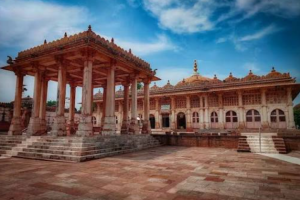
On November 24, 2026, the cultural advocacy group Saanjhi Virasat organised a night walk titled “Saaya-o-Sukoon” at the historic Sarkhej Roza complex in Ahmedabad. The event, held during World Heritage Week, sought to showcase the 15th-century monument’s unique Indo-Saracenic architecture and underline its significance as a shared cultural heritage site.
Sarkhej Roza, an Archaeological Survey of India-protected monument of national importance, is renowned for blending Islamic and Hindu design elements. Unlike many Islamic monuments, it notably lacks prominent arches and minarets, instead featuring pierced stone trellises that provide structural support. The complex’s layout intricately connects religious, royal, and public spaces, linking the mosque and courtyard with spiritual life, the tombs and palaces with royalty, and the tank and pavilions with communal use.
Ahmedabad’s Heritage Under Threat Amid Urban Expansion
Despite its cultural value, Ahmedabad’s heritage sites face increasing risks. On November 22, 2026, experts raised alarms that nearly 30% of heritage buildings in Ahmedabad’s traditional pols are in a state of disrepair, with 100 out of 500 surveyed houses either demolished or severely damaged. This decline reflects broader challenges in protecting the city’s historic fabric amid rapid urbanisation.
In Sarkhej Roza’s vicinity, environmental concerns compound preservation difficulties. Research published in July 2026 revealed that over half of the Sarkhej Lake catchment area has been encroached upon by development, disrupting natural stormwater flows and accelerating the lake’s drying. This ecological imbalance threatens the monument’s surrounding landscape, integral to its historical setting.
Steps Toward Heritage Conservation and Regulatory Oversight
The Ahmedabad Municipal Corporation is moving to formally protect more of the city’s heritage. After nearly 12 years of delay, a proposal to grant heritage status to 382 historically significant structures outside the Old City was presented to the Heritage and Recreation Committee on August 24, 2026. Unfortunately, prior to this move, seven important buildings, including the Tripathi House in Sarkhej, were lost to demolition.
UNESCO and the International Council on Monuments and Sites (ICOMOS) conducted a four-day audit starting March 18, 2026, examining Ahmedabad’s historic core and redevelopment projects such as the Kalupur Railway Station. Following their assessment, UNESCO recommended a 15-metre height restriction for new buildings in the Old City and mandated Heritage Impact Assessments to ensure new construction respects the area’s character.
Legacy of Sultan Mahmud Begada’s Contributions
Sultan Mahmud Begada, a key historical figure, expanded Sarkhej Roza by creating the adjacent lake, constructing a palace beside it, and erecting a family mausoleum opposite the saint’s tomb. These additions enriched the complex’s architectural and cultural significance, making it a vital symbol of Ahmedabad’s heritage.
The night walk by Saanjhi Virasat not only illuminated Sarkhej Roza’s architectural marvels but also served as a call to action for preserving Ahmedabad’s endangered heritage. As urban pressures mount, safeguarding these historic sites remains crucial to maintaining the city’s cultural identity and historical continuity.