The Reserve Bank of India (RBI) issued the Reserve Bank of India (White Label ATM Operators) Directions, 2026, on 27 November 2026, which came into effect immediately. This regulatory framework consolidates the rules governing non-bank entities operating White Label ATMs (WLAs) across the country, aiming to strengthen the ATM network and ensure financial stability.
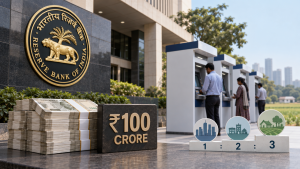
Under the new guidelines, non-bank entities seeking to set up, own, and operate White Label ATMs must obtain authorisation as per the RBI’s Master Direction on Authorisation to operate a Payment System, dated 15 June 2026. A key requirement is maintaining a minimum net worth of ₹100 crore at all times, a significant increase designed to ensure that operators have the financial strength to sustain ATM operations and manage risks effectively.
Deployment Norms to Boost ATM Accessibility
The RBI has mandated that White Label ATM Operators (WLAOs) maintain a deployment ratio of at least 1:2:3 across metro or urban, semi-urban, and rural centres respectively. This means for every metro ATM deployed, operators must install two in semi-urban areas and three in rural locations. The central bank will review compliance with these norms at least every six months to ensure that ATM infrastructure expands beyond urban centres and reaches underserved regions.
Importantly, WLAOs are prohibited from taking over existing bank-operated ATMs or charging bank customers directly for ATM usage. Instead, they may receive fees from banks for facilitating ATM transactions. This preserves the customer’s cost experience while allowing operators to earn revenue through bank partnerships.
Cash Management and Service Expansion
White Label ATM Operators can source cash from multiple sponsor banks and other scheduled banks, including cooperative banks and regional rural banks. Additionally, they are permitted to purchase wholesale cash exceeding one lakh pieces directly from RBI Issue Offices and Currency Chests, provided full payment is made. This flexibility aims to streamline cash supply and reduce downtime at ATMs.
Following certification from the National Payments Corporation of India (NPCI), WLAOs may also offer enhanced services such as card-less cash withdrawals, bill payments, and interoperable cash deposits. These features align with the broader push towards digital and interoperable payment systems in India.
Operators must submit monthly transaction statistics through the Centralised Information Management System (CIMS) portal by the seventh day of the following month. In case of failed transactions, the Issuing Bank holds primary responsibility for grievance redressal, supported by the Sponsor Bank to ensure customer issues are resolved promptly.
Implications for Financial Inclusion and ATM Network Growth
White Label ATMs serve as an independent alternative to traditional bank-owned ATMs, helping expand cash access in areas where banks have limited presence. The RBI’s directives reinforce the importance of a robust ATM network by imposing financial and operational standards on operators.
In India, cardholders using White Label ATMs are entitled to five free transactions per month, with operators compensated through interchange fees paid by card-issuing banks. This arrangement encourages operators to maintain and expand ATM services without burdening customers.
The Payment and Settlement Systems Act, 2007, empowers the RBI to regulate and supervise payment systems, including authorising White Label ATM operators. The National Payments Corporation of India manages the National Financial Switch, an interoperable ATM network that routes transactions between banks, enabling customers to use ATMs of banks other than their own seamlessly.
By setting a ₹100 crore net worth requirement and enforcing deployment ratios, the RBI aims to ensure that White Label ATM operators are financially sound and contribute meaningfully to expanding ATM access, especially in rural and semi-urban areas. This move is expected to strengthen the cash infrastructure and support financial inclusion across India.