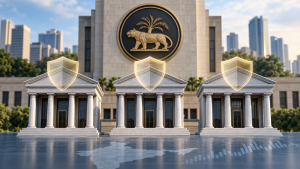
On November 23, 2026, the Reserve Bank of India (RBI) announced that it has retained three major banks—State Bank of India (SBI), HDFC Bank, and ICICI Bank—on its list of Domestic Systemically Important Banks (D-SIBs) for the year 2026. This designation means these banks are considered crucial to the stability of India’s financial system and must maintain additional capital buffers to absorb potential losses.
Understanding Domestic Systemically Important Banks
Domestic Systemically Important Banks, or D-SIBs, are banks whose failure could disrupt the entire financial system due to their size, complexity, and interconnectedness. The RBI introduced the D-SIB framework in July 2014 to identify such banks and ensure they hold extra capital to protect against financial shocks. This framework was updated in December 2023 to refine the assessment process and enhance transparency through annual public disclosures.
The RBI evaluates banks based on several systemic-risk indicators, including their size, complexity, interconnectedness with other financial institutions, availability of substitutes, and cross-jurisdictional activities. These factors help determine the level of risk a bank poses to the broader economy.
Capital Buffer Requirements for 2026
Each D-SIB is assigned to a specific 'bucket' that dictates the additional Common Equity Tier 1 (CET1) capital buffer it must maintain. CET1 capital primarily includes common stock, retained earnings, and reserves, serving as a cushion against losses. These buffers are over and above the mandatory Capital Conservation Buffer required for all banks.
- State Bank of India (SBI): Placed in Bucket 4, SBI must hold an additional CET1 capital buffer of 0.80% of its risk-weighted assets (RWAs).
- HDFC Bank: In Bucket 2, HDFC Bank is required to maintain a 0.40% additional CET1 buffer.
- ICICI Bank: Assigned to Bucket 1, ICICI Bank must hold a 0.20% additional CET1 buffer.
Risk-weighted assets are calculated by applying regulatory credit-risk weights to different asset classes. For example, cash typically carries a zero risk weight, while certain loans may be counted at their full value. These calculations help determine the capital a bank needs to hold relative to its risk exposure.
Why Maintaining D-SIB Status Matters
Being classified as a D-SIB signals a bank’s significant role in the financial system. The additional capital buffers required help ensure these banks remain resilient during economic downturns or financial crises, reducing the risk of failure that could have widespread consequences.
For SBI, HDFC Bank, and ICICI Bank, retaining their D-SIB status means continuing to meet higher regulatory standards, which can influence their lending practices, risk management, and overall financial health. It also reassures depositors and investors that these institutions are closely monitored and better prepared to withstand shocks.
The RBI’s ongoing assessment and public disclosure of D-SIBs promote transparency and encourage banks to strengthen their risk management frameworks. This approach supports the stability of India’s banking sector and protects the broader economy.
Frequently Asked Questions
Q: What is a Domestic Systemically Important Bank (D-SIB)?
A: A D-SIB is a bank whose failure could significantly disrupt the domestic financial system due to its size, complexity, and interconnectedness. These banks are subject to higher regulatory capital requirements to reduce systemic risk.
Q: How does the RBI determine the capital buffer for each D-SIB?
A: The RBI assigns banks to different buckets based on systemic-risk indicators. Each bucket corresponds to a specific additional Common Equity Tier 1 (CET1) capital buffer percentage that the bank must maintain over the standard requirements.
Q: Why are capital buffers important for banks?
A: Capital buffers act as financial cushions that help banks absorb losses during economic stress, reducing the risk of failure and protecting the stability of the financial system.