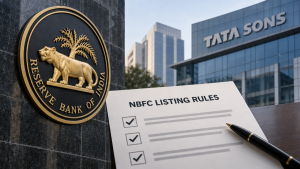
On November 16, 2026, the Reserve Bank of India (RBI) formally directed Tata Sons to adhere to the listing regulations applicable to Upper Layer Non-Banking Financial Companies (NBFC-UL). This directive came in response to a query from Tata Sons’ Chief Financial Officer regarding compliance, originally sent on October 6. The RBI’s communication explicitly mentioned the requirement for listing, underscoring the urgency for Tata Sons to meet regulatory standards.
Understanding NBFC-UL Classification and Listing Requirements
Non-Banking Financial Companies (NBFCs) are financial institutions that provide banking services without holding a banking license. The RBI classifies NBFCs into various categories based on their size and activities. Tata Sons was categorized as an Upper Layer NBFC (NBFC-UL) in September 2022, a classification reserved for entities with assets exceeding ₹1 trillion. This classification imposes stricter regulatory requirements, including mandatory listing on stock exchanges within three years of classification.
The deadline for Tata Sons to complete its listing was September 30, 2025. However, the company has yet to fulfill this obligation. In an attempt to avoid this, Tata Sons applied in March 2024 to surrender its registration as a Core Investment Company (CIC), a move that could have exempted it from NBFC-UL listing rules. The RBI rejected this application in September 2026, reinforcing the company’s obligation to comply with the listing mandate. As of March 31, 2026, Tata Sons’ assets stood at approximately ₹2.01 lakh crore, well above the threshold for NBFC-UL classification.
Internal Divisions and Market Reactions
The directive has exposed differing views within Tata Sons’ leadership and major stakeholders. Tata Trusts, which owns about 66% of Tata Sons, opposes the listing. Chairman Noel Tata has expressed concerns that going public could shift the company’s focus away from long-term philanthropic goals toward short-term profit pressures. Conversely, Tata Sons Chairman N Chandrasekaran and a majority of the board members support moving forward with the listing to comply with RBI regulations.
The debate is set to be a key agenda item at the upcoming board meeting scheduled for November 26, 2026. Meanwhile, the market has reacted positively to the possibility of a listing, with shares of Tata Chemicals and Tata Investment Corporation rising on November 17 amid speculation about the development.
Key Facts About NBFCs and Their Regulatory Environment
- NBFCs provide financial services similar to banks but do not offer cheque books or savings and current accounts.
- They are classified based on whether they accept public deposits, with Upper Layer NBFCs being large entities subject to more stringent rules.
- NBFCs can tailor financial products to meet specific client needs, often unbundling packaged services.
Why RBI’s Directive Matters for Tata Sons and the Industry
The RBI’s insistence on Tata Sons’ compliance highlights the regulator’s commitment to transparency and accountability in the financial sector, especially for large NBFCs. Listing on stock exchanges would subject Tata Sons to greater public scrutiny, disclosure norms, and corporate governance standards. This could impact the company’s strategic decisions and shareholder dynamics, especially given the current internal disagreements.
For the broader financial industry, this move signals that the RBI is enforcing its regulations firmly, even against powerful conglomerates. It underscores the evolving regulatory landscape where large NBFCs must balance growth ambitions with compliance and governance demands.
Frequently Asked Questions
Q: What is an Upper Layer Non-Banking Financial Company (NBFC-UL)?
A: NBFC-UL refers to large non-banking financial companies with assets exceeding ₹1 trillion. They are subject to stricter regulatory requirements, including mandatory stock exchange listing within a specified timeframe.
Q: Why does Tata Sons need to list on the stock exchange?
A: As an NBFC-UL, RBI regulations require Tata Sons to list publicly within three years of classification to ensure transparency and regulatory oversight. Tata Sons missed the September 2025 deadline, prompting RBI’s directive.
Q: What are the concerns about Tata Sons going public?
A: Major shareholders like Tata Trusts worry that listing could shift the company’s focus from long-term philanthropic goals to short-term profit pressures, potentially altering its strategic priorities.