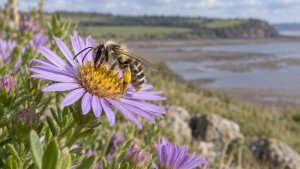
The sea aster mining bee, a rare solitary bee species, has been recorded for the first time in Somerset at the WWT Steart Marshes and Bridgwater Bay National Nature Reserve. The discovery was made by local naturalist and Wildfowl & Wetlands Trust life member Nigel Phillips in late October and November 2026. This marks a significant expansion of the bee's known range, which was previously limited to the south and east coasts of the UK.
Phillips observed several tiny bees and their nesting areas in dry, sandy ground within the reserve. The sea aster mining bee is notably small, rarely exceeding the size of a thumbnail. It is a solitary species that feeds exclusively on the sea aster flower, a pink-and-yellow bloom that appears late in the season on coastal saltmarshes. The presence of this bee in Somerset had not been recorded before, nor in the neighbouring counties, making this sighting a noteworthy addition to the region's biodiversity records.
Coastal Habitat Restoration Spurs Biodiversity Gains
The appearance of the sea aster mining bee in Somerset is closely linked to the saltmarsh restoration project completed in 2014 at WWT Steart Marshes. This project involved redirecting saltwater onto previously intensively farmed fields, transforming them back into natural saltmarsh habitat. This restored environment supports a variety of coastal plants, including the sea aster, which in turn provides a vital food source for the mining bee and other insects.
WWT Site Manager Alys Laver emphasized the significance of the discovery, stating, "This record is a clear indication that restoring coastal habitats can create conditions that support rare and specialized species like the sea aster mining bee." The restoration of the saltmarsh not only benefits plant life but also fosters the return of insects that depend on these plants, contributing to the overall health and resilience of the ecosystem.
Life Cycle and Nesting Habits of the Sea Aster Mining Bee
The sea aster mining bee is a solitary species, meaning each female builds and provisions her own nest. However, these bees often nest in large aggregations that can number in the thousands, creating dense nesting sites in suitable sandy soils. Each female's nest burrow ends in a cluster of approximately six cells where she lays eggs and stores pollen and nectar to feed the developing larvae.
This species has a univoltine life cycle, with adults emerging in late summer to forage and reproduce. The next generation remains in the nest cells through the winter, emerging the following year to continue the cycle. The bee's specialized dependence on sea aster flowers ties its survival closely to the health of coastal saltmarsh habitats.
The discovery of the sea aster mining bee in Somerset underscores the importance of habitat restoration projects and highlights the potential for rare species to recolonize areas where suitable conditions are restored. It also serves as a reminder of the intricate connections between plant and insect species in coastal ecosystems and the need to protect these habitats from degradation.