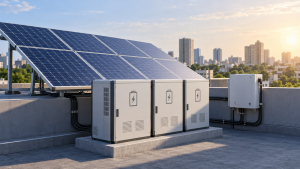
On November 23, 2026, the Union Ministry of Power released a draft amendment to the Electricity (Rights of Consumers) Rules, 2020, proposing mandatory battery storage for larger rooftop solar installations. These rules are scheduled to come into effect on April 1, 2028, marking a significant step toward integrating renewable energy with grid management.
The draft mandates that State Electricity Regulatory Commissions (SERCs) set capacity thresholds above which consumers must install energy storage systems alongside their rooftop solar setups. If a SERC does not specify a threshold, the default requirement will apply to installations exceeding 10 kilowatts (kW). The proposed minimum battery storage capacity is at least 20% of the daily solar generation, although SERCs may set different proportions based on local grid conditions.
Balancing Solar Generation with Grid Demand
The rationale behind the proposal is to encourage consumers to store surplus solar energy generated during the day for use during evening peak demand hours. This shift aims to reduce stress on the electricity grid and lower operational costs for distribution companies by smoothing out demand fluctuations. Additionally, SERCs may impose charges on rooftop solar consumers with systems above certain capacities to account for storage costs and network losses.
Consumers will also be allowed to install renewable energy systems elsewhere on their premises, provided the total capacity does not exceed their sanctioned load and complies with SERC limits. This flexibility could facilitate more efficient use of available space for solar installations.
Time-of-Day Tariffs and Regulatory Context
The draft postpones the implementation of time-of-day (ToD) tariffs, which vary electricity prices based on consumption timing, to April 1, 2028, for consumers with maximum demand above 10 kW. For other non-agricultural consumers, ToD tariffs would take effect from April 1, 2029. These tariffs aim to incentivize consumers to shift electricity use to off-peak hours, complementing the battery storage requirements.
Under the Electricity Act, 2003, SERCs regulate intra-state electricity matters, including retail tariffs and consumer rights, while the Central Electricity Regulatory Commission oversees inter-state issues. The proposed amendments reflect this regulatory framework by empowering state commissions to tailor storage and tariff policies according to local needs.
Technical Considerations for Battery Storage
Battery storage systems store energy as direct current (DC), whereas electricity networks operate on alternating current (AC). Therefore, inverters are necessary to convert stored DC power to AC for grid compatibility. This technical aspect is critical for integrating battery storage with existing rooftop solar systems.
Time-of-use electricity prices are typically set in advance and adjusted no more than twice annually, allowing consumers to plan their energy consumption around cheaper periods effectively. The draft also touches on net and gross metering mechanisms, where net metering offsets electricity exported to the grid against consumption, and gross metering credits all generated electricity separately.