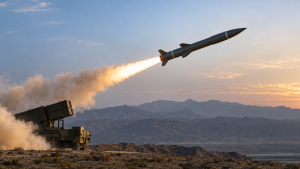
On November 18, 2026, Pakistan’s military announced the successful test-firing of the Fatah-3 supersonic cruise missile. The Inter-Services Public Relations (ISPR), the military’s media wing, highlighted the missile’s advanced navigation and propulsion systems that allow it to hit distant targets at supersonic speeds.
Advancing Pakistan’s Missile Technology
The Fatah-3 missile represents a significant step in Pakistan’s efforts to modernize and expand its missile arsenal. Unlike traditional ballistic missiles that follow a high-arc trajectory, cruise missiles like the Fatah-3 generate aerodynamic lift and remain powered throughout most of their flight within the atmosphere. This capability allows for more controlled and precise targeting, making the missile a versatile tool for strategic defense.
The test was observed by high-ranking officials, including the Commander of the Army Rocket Force Command, senior officers from the Pakistan Armed Forces, and the scientists and engineers who developed the missile. The military stated that the induction of the Fatah-3 will enhance the operational flexibility and strike range of the Rocket Force Command, thereby strengthening Pakistan’s conventional deterrence posture.
Recent Developments in Pakistan’s Missile Program
- On November 3, 2026, Pakistan conducted a flight test of Fa’az, the country’s first indigenously developed air-to-air missile.
- Earlier in October, on the 13th, Pakistan tested the Fatah-2, an extended-range hypersonic ballistic missile.
- On October 6, an extended version of the Fatah-IV ground-launched cruise missile was also tested.
These tests demonstrate Pakistan’s ongoing commitment to advancing its missile technology across various platforms, including air-to-air, ballistic, and cruise missile systems.
Why the Fatah-3 Test Matters for Regional Security
The successful test of the Fatah-3 missile is significant because it enhances Pakistan’s ability to conduct precision strikes at supersonic speeds, which can complicate interception efforts by adversaries. The missile’s terrain-aided navigation system, which combines inertial navigation with terrain contour matching, allows it to correct its course by comparing ground profiles against stored maps. This feature increases accuracy and reduces the chance of detection.
By expanding the operational reach of its Rocket Force Command, Pakistan is signaling a boost in its conventional deterrence capabilities. This development is likely to impact the strategic balance in South Asia, where missile technology plays a critical role in national defense strategies.
Frequently Asked Questions
Q: What distinguishes a cruise missile like the Fatah-3 from a ballistic missile?
A: Cruise missiles generate aerodynamic lift and remain powered during most of their flight, allowing for controlled and precise navigation, unlike ballistic missiles which follow a ballistic trajectory after an initial powered phase.
Q: What is terrain-aided navigation in cruise missiles?
A: Terrain-aided navigation combines inertial navigation with terrain contour matching, where the missile compares measured ground features with stored maps to correct its position and improve accuracy.
Q: How does the Fatah-3 test affect Pakistan’s military capabilities?
A: The Fatah-3 enhances Pakistan’s operational flexibility and strike range, strengthening its conventional deterrence by enabling precise, supersonic strikes on distant targets.