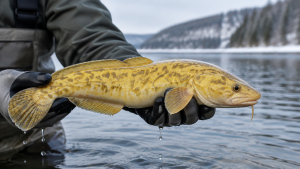
In November 2026, biologists from the U.S. Fish and Wildlife Service made an extraordinary discovery in Oswego Harbor on Lake Ontario, Upstate New York. During a routine survey targeting aquatic invasive species, the team caught a yellow burbot, a fish rarely seen in this region and notable for its unusual coloration.
Understanding the Yellow Burbot and Its Unique Coloration
The yellow-orange hue of this burbot is caused by a rare genetic mutation known as xanthochromism, which reduces the typical dark pigments found in most fish. This condition is much less common than other pigmentation variations like albinism or melanism. The mutation gives the fish a striking appearance, setting it apart from the usual olive or brownish tones of burbot. Unfortunately, the specimen appeared emaciated and in poor health when caught, prompting its transfer to Cornell University College of Veterinary Medicine for detailed health evaluation. Jake Cochran, a fish biologist involved in the survey, helped present the fish to the public and scientific community.
Burbot Presence in Oswego Harbor and Lake Ontario
Burbot are generally scarce in Lake Ontario, preferring the lake's deeper, colder waters rather than the shallower harbor areas. This catch marked the first officially documented burbot during a fisheries survey in Oswego Harbor, although local anglers had occasionally reported catching them there. The discovery sheds light on the species' elusive presence in the harbor and raises questions about their habitat range and population status in the region.
Key Characteristics and Biology of the Burbot
- Unique Taxonomy: The burbot is the only freshwater fish in the order Gadiformes, a group mostly made up of marine species.
- Distinctive Chin Barbel: It has a single barbel on its chin, a key feature used to identify the species.
- Benthic Lifestyle: Its relatively small fins indicate adaptation to living near the lake bottom, with limited ability to swim against strong currents.
- Reproduction: Burbot are broadcast spawners, releasing eggs and sperm into the water without building nests, allowing the fertilized eggs to drift and settle naturally.
Why This Discovery Matters for Conservation and Research
Finding a yellow burbot in Oswego Harbor is significant for several reasons. It highlights the presence of a rare genetic variant in a species already uncommon in Lake Ontario. The poor health of the fish raises concerns about environmental stresses or population pressures affecting burbot in the area. This discovery encourages further research into the species’ distribution, health, and genetic diversity. It also underscores the importance of ongoing monitoring efforts by wildlife agencies to protect vulnerable aquatic species and maintain biodiversity in the Great Lakes region.
Frequently Asked Questions
Q: What causes the yellow coloration in this burbot?
A: The yellow color results from xanthochromism, a rare genetic mutation that reduces dark pigmentation, giving the fish a yellow-orange appearance.
Q: Why is the burbot rare in Lake Ontario?
A: Burbot prefer deep, cold waters and are generally found in low numbers in Lake Ontario. Their presence in shallower harbor areas like Oswego is uncommon.
Q: How do burbot reproduce?
A: Burbot are broadcast spawners, releasing eggs and sperm into the water without building nests, allowing fertilized eggs to drift and settle on the lake bottom.