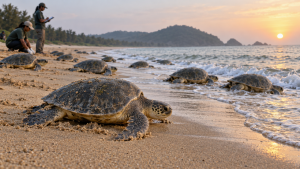
Conservation and research of Olive Ridley sea turtles saw significant expansion in 2026, marked by new nesting discoveries and enhanced protection initiatives across multiple regions. Notably, in September, two Olive Ridley nests were found at Seal Beach and Huntington Beach in Southern California, representing the first confirmed natural sea turtle nesting events on the U.S. West Coast. These findings highlight a potential shift in the species’ nesting range and underscore the importance of ongoing monitoring.
On November 14, 54 Olive Ridley hatchlings were released into the Pacific Ocean after receiving care at the Aquarium of the Pacific. The aquarium had opened a dedicated sea turtle rehabilitation area earlier in January, doubling its capacity to care for injured or displaced turtles. This release marked a successful outcome of conservation efforts aimed at increasing hatchling survival rates.
Record Nesting Activity Along Indian Coastline and Northernmost Nest Discovery
During the 2024–25 nesting season, the Wildlife Institute of India documented over 18,000 solitary Olive Ridley nests along the mainland coastline, indicating robust nesting activity in the region. In November 2026, 33 eggs from a nest at Ventura Beach, California, were sent to the Santa Barbara Zoo for evaluation after being washed out by high swells. Although none of these eggs showed signs of development, the nest itself was the northernmost ever recorded for the species, suggesting possible range expansion or shifting nesting behaviors.
New Research and Protection Initiatives Across the Indian Ocean and Africa
The Olive Ridley Project launched the Sea Turtle Health Institute on Jawakara Island in the Maldives’ Lhaviyani Atoll, establishing the Indian Ocean’s first dedicated sea turtle hospital. This institute supports multi-year research revealing changing nesting patterns in the Maldives, including emerging Olive Ridley activity. Meanwhile, in Kenya, the ORP–Kenya program began protecting nesting turtles and their habitats at Jumba Beach through scientific monitoring combined with community engagement.
In Pakistan, a collaborative review involving WWF-Pakistan and Lasbela University of Agriculture, Water & Marine Sciences identified six critical research gaps related to Olive Ridley sea turtles, highlighting the need for enhanced study and conservation efforts in the region. Additionally, the Olive Ridley Project’s ORPTrack satellite-tagging program released a turtle named Vindhu in January 2026 to study feeding habits in the open ocean, providing valuable data for species management.
Key Biological and Conservation Facts About Olive Ridley Turtles
- Arribada nesting: Olive Ridleys exhibit both solitary nesting and arribadas, where thousands of females simultaneously lay eggs on the same beach over a brief period.
- Temperature-dependent sex determination: The sex of hatchlings depends on nest incubation temperature, with warmer conditions generally producing females and cooler conditions males.
- Multiple clutches: Females often lay multiple clutches during a nesting season, typically spaced about two weeks apart.
- CITES protection: Olive Ridleys are listed under CITES Appendix I, which restricts international commercial trade of wild-caught specimens to protect the species from exploitation.
The expansion of conservation sites and research initiatives in 2026 reflects a growing global commitment to safeguarding Olive Ridley sea turtles. These efforts are crucial as the species faces threats from habitat loss, climate change, and human interference. Continued monitoring, community involvement, and scientific study remain vital to ensuring the survival of this vulnerable marine species.