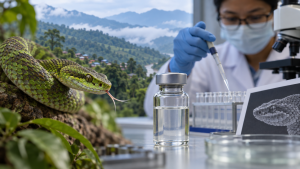
On November 25, 2026, a research team led by Professor Ashis K. Mukherjee, Director of the Institute of Advanced Study in Science and Technology (IASST) in Guwahati, announced the development of a new bivalent antivenom specifically targeting two pit viper species prevalent in Northeast India. This breakthrough aims to improve treatment outcomes for snakebite victims in the region, where existing antivenoms have limited efficacy against local snake species.
The newly developed antivenom neutralises venom from Pope's pit viper (Trimeresurus popeiorum) and the red-tailed bamboo pit viper (Trimeresurus erythrurus). Venom samples were collected from Mizoram and Meghalaya, ensuring the antivenom is regionally tailored. Published in the International Journal of Biological Macromolecules on September 22, 2026, the study demonstrated that this equine F(ab)₂ bivalent antivenom shows superior venom-neutralising activity compared to the current Indian polyvalent antivenom. Laboratory and preclinical tests also revealed that it causes less disruption to blood coagulation and reduces local and organ tissue damage.
Addressing a Gap in Snakebite Treatment in Northeast India
India's existing polyvalent antivenom primarily targets the 'Big Four' venomous snakes: Russell's viper, spectacled cobra, common krait, and saw-scaled viper. However, this antivenom has limited effectiveness against several medically significant snakes in Northeast India, including various pit viper species. Snakebite envenomation remains a serious public health issue in the region, with pit vipers contributing to a significant proportion of cases.
Professor Mukherjee highlighted that the newly developed antivenom is a crucial step toward addressing this gap but cautioned that it still requires comprehensive clinical and regulatory evaluation before it can be widely used in medical settings. "While our preclinical results are promising, clinical trials are essential to confirm safety and efficacy in patients," he said.
Collaborative Effort and Scientific Innovation
The development of this bivalent antivenom was a collaborative effort involving Premium Serums and Vaccines Pvt. Ltd., Amrita Research Centre, Mizoram University, and the conservation organization Aaranyak. The antivenom is produced using equine plasma, employing plasmapheresis to collect plasma rather than whole blood serum. The F(ab)₂ fragments are generated through pepsin digestion of equine IgG antibodies, which retains the antigen-binding sites while removing the Fc region to reduce adverse reactions.
Antivenoms can be monovalent, targeting a single species or toxin, or polyvalent, effective against multiple species. The specificity of antivenoms is critical because venom composition varies geographically and taxonomically, and cross-neutralisation between related snake species is not guaranteed. This regional specificity makes the new antivenom particularly valuable for Northeast India.
Snakebite envenomation continues to be a neglected tropical disease, especially in rural and forested areas where access to appropriate treatment is limited. The development of this antivenom tailored to local snake species represents a significant advancement in reducing morbidity and mortality associated with pit viper bites in Northeast India.