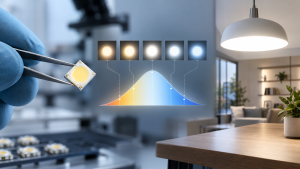
On November 27, 2026, researchers at the Centre for Nano and Soft Matter Sciences (CeNS) in Bengaluru, in collaboration with the Indian Institute of Technology Delhi, announced a breakthrough in white light-emitting diode (LED) technology. They developed a novel dual-protection strategy using halide perovskite nanocrystals to produce stable, scalable white LEDs with tunable color temperatures. This innovation aims to provide flexible, cost-effective lighting solutions while reducing reliance on rare-earth elements and avoiding complex high-temperature manufacturing processes.
The new approach addresses a major challenge in perovskite-based LEDs: color instability caused by anion exchange. This phenomenon occurs when halide ions migrate between nanocrystals of different compositions, such as green-emitting cesium lead bromide (CsPbBr₃) and red-emitting cesium lead iodide (CsPbI₃), leading to blurred and unstable color output.
Dual-Protection Strategy to Prevent Color Instability
The research team tackled this problem by introducing lead selenide (PbSe) nanocrystals to reduce halide vacancies on the surfaces of the perovskite crystals. These vacancies typically facilitate ion migration, which causes the color shifts. In addition, they applied a physical barrier to block ion diffusion between nanocrystals, effectively preventing the anion exchange that destabilizes color emission.
This dual-protection method stabilizes the crystal surfaces and confines ion movement, ensuring that the LEDs maintain their intended color output over extended periods. The researchers demonstrated that their optimized LEDs could sustain stable white light emission for up to 24 hours of continuous operation, including through cycles of heating and cooling.
Scalable Fabrication and Tunable Lighting on Flexible Substrates
The team fabricated the LEDs using spray-coating and micropatterning techniques on both rigid glass substrates and flexible polyethylene terephthalate (PET) films. This versatility opens the door to applications in flexible lighting devices and wearable technologies.
By adjusting the electrical current supplied to the LEDs, the emitted light can be tuned from a dim white to a warm white tone, allowing for customizable lighting environments. This tunability is a significant advantage for energy-efficient lighting systems and smart illumination solutions.
The findings were published in the journal Small, highlighting the potential for these perovskite-based LEDs to offer a low-cost, scalable alternative to conventional white LEDs that often depend on rare-earth phosphors and high-temperature fabrication methods.
However, the researchers caution that further studies are needed to address concerns related to lead toxicity and environmental safety before these devices can be commercialized widely. Lead selenide, which forms cubic crystals with a sodium chloride structure and has a direct bandgap of 0.27 eV at room temperature, is a key component in this technology but requires careful handling and disposal protocols.
Scientific Insights Underpinning the Innovation
The perovskite lattice framework used in this technology follows the ABX₃ structure, where metal-halide octahedra share corners. By altering the halide composition within this lattice, researchers can tune the electronic bandgap and thus the color of emitted light. However, vacancy-mediated ion migration—where ions hop into neighboring vacant lattice sites—can disrupt this stability, leading to color shifts.
Embedding lead selenide nanocrystals as quantum dots within the perovskite matrix helps mitigate these vacancies, stabilizing the crystal structure and reducing ion migration. This scientific insight enables the creation of LEDs that combine high color purity, stability, and tunability.