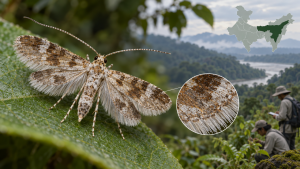
A previously unknown species of micro-moth, named Glyphipterix brevimucronata, has been discovered near the Hollongapar Gibbon Sanctuary in Mariani, located in Assam's Jorhat district. This discovery was made during a field survey conducted on October 2, 2025, at an elevation of 141 meters, adding a significant new entry to the region's biodiversity.
Understanding the New Moth Species
The newly identified moth is remarkably small, with a wingspan measuring just 6.5 millimeters. Its forewings are brown with a yellowish metallic sheen, adorned with distinctive white markings that help differentiate it from other species. The scientific name, Glyphipterix brevimucronata, is derived from Latin terms meaning "short" and "pointed," which describe a unique short, pointed structure found in the male reproductive anatomy of the moth. This discovery was documented by Kishore Chandra Sahoo from the ICAR-Indian Agricultural Research Institute (IARI) in Assam and published in the scientific journal Zootaxa in 2026.
Significance of the Discovery in Indian Entomology
This finding is particularly notable because it represents the first new addition to India's sedge moth family, Glyphipterigidae, in nearly 100 years. The last species from this genus was catalogued in 1923, making this a rare and important event in the study of Indian moths. Globally, the Glyphipterigidae family includes over 530 known species, but only 25 had been previously recorded in India. The discovery has been welcomed by Assam's Chief Minister Himanta Biswa Sarma and Forest Minister Jayanta Malla Baruah, highlighting its importance for regional biodiversity and conservation efforts.
Key Facts About Glyphipterix brevimucronata and Its Family
- The larvae of many Glyphipterigidae species feed on sedges and rushes, which is why they are commonly called sedge moths.
- The genus name Glyphipterix was confirmed by the International Commission on Zoological Nomenclature (ICZN) as the correct spelling, rejecting the earlier variant Glyphipteryx.
- "Micro-moth" is an informal term used to describe small moths across various families and does not represent a formal scientific classification.
- According to ICZN rules, any animal species described after 1999 must have a designated type specimen and a clear record of where this specimen is stored, which was followed in this case.
Why This Discovery Matters for Biodiversity
The identification of Glyphipterix brevimucronata enriches the understanding of moth diversity in India, especially in the ecologically rich region of Assam. It underscores the importance of ongoing field surveys and scientific research in uncovering hidden species that contribute to the complexity of local ecosystems. Such discoveries can inform conservation strategies, particularly in protected areas like the Hollongapar Gibbon Sanctuary, which is known for its unique wildlife. This new species also highlights how much remains to be explored in India's insect fauna, encouraging further studies that could reveal more undiscovered species.
Frequently Asked Questions
Q: Where was the new micro-moth species discovered?
A: It was found near the Hollongapar Gibbon Sanctuary in Mariani, Jorhat district, Assam.
Q: What is unique about Glyphipterix brevimucronata?
A: It has a small wingspan of 6.5 millimeters, brown forewings with a yellowish metallic sheen, and distinctive white markings. Its name refers to a short, pointed structure in the male reproductive system.
Q: Why is this discovery important?
A: It is the first new addition to India's sedge moth family in nearly a century, expanding knowledge of the region's biodiversity and aiding conservation efforts.