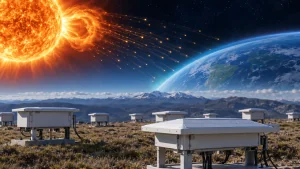
On November 26, 2026, the Indian Institute of Geomagnetism (IIG), Mumbai, announced a breakthrough in detecting rare and extreme solar particle events known as Ground-Level Enhancements (GLEs). These events involve high-energy solar particles that reach Earth's surface, posing risks to satellites, astronauts, and power grids. IIG scientists developed cost-effective detectors installed at India's polar research stations in Ny-Ålesund (Svalbard) and Antarctica to monitor these phenomena more efficiently.
GLEs are infrequent but intense bursts of solar energetic particles with energies exceeding 400 MeV, significantly higher than typical solar particle events. These particles can penetrate Earth's magnetic shield and atmosphere, creating measurable increases in radiation at ground level. Tracking GLEs is critical for understanding solar activity and mitigating its impact on technology and human health.
Detecting GLE #77 from Both Hemispheres
During a powerful solar storm on November 11, 2025, IIG's polar detectors simultaneously recorded GLE signatures from both the Northern and Southern Hemispheres for the first time. This event, classified as GLE #77, followed an intense X-class solar flare accompanied by a fast coronal mass ejection (CME). The detection was made using sodium iodide thallium-activated (NaI(Tl)) scintillation detectors, which are sensitive to gamma rays produced during these energetic particle events.
The research, published in the Astrophysical Journal Letters, demonstrated that compact ground-based gamma-ray detectors can effectively complement traditional neutron monitors used worldwide for space weather surveillance. This dual-hemisphere detection capability enhances global understanding of solar particle propagation and improves early warning systems. IIG operates autonomously under India's Department of Science and Technology.
Artificial Intelligence Advances Solar Flare Forecasting
In related developments, a team from the New Jersey Institute of Technology introduced EarlyDetect, an artificial intelligence model that forecasts solar flares by identifying subtle precursors an average of 9.24 hours before flare onset. EarlyDetect uses a Transformer neural network architecture to analyze hourly acoustic power maps and magnetic field data from NASA’s Solar Dynamics Observatory. This advancement, published in the Journal of Geophysical Research: Machine Learning and Computation in August 2026, promises to improve preparedness for space weather hazards.
Ground-level solar particle events like GLEs pose challenges due to their rarity and intensity. The IIG’s new detection method using NaI(Tl) scintillation detectors offers a cost-effective and scalable solution, particularly valuable at remote polar stations where monitoring infrastructure is limited. These detectors identify gamma rays generated by high-energy particles, enabling more comprehensive tracking of solar activity.
GLE events are classified by the energy of solar particles detected and the geographic spread of their effects. A sub-GLE event, for instance, requires significant increases at two high-altitude neutron monitors and enhanced proton flux observed by spacecraft, but no notable rise at sea-level monitors. This distinction helps scientists categorize the intensity and potential impact of solar particle events.
By integrating ground-based gamma-ray detectors with existing neutron monitors and leveraging AI-based forecasting tools, researchers aim to build a robust global network for space weather monitoring. This network will support timely alerts and risk mitigation strategies for satellite operators, aviation, power grids, and other sectors vulnerable to solar storms.