Researchers from the Thackeray Wildlife Foundation in Mumbai have discovered a previously unknown species of Begonia in Arunachal Pradesh’s Upper Siang district. The plant, named Begonia siangensis, was identified after detailed botanical studies conducted by S. Kishwan, T. U. Thackeray, and N. V. Page. This discovery was formally published in the Edinburgh Journal of Botany on October 27, 2026.
Where and How Begonia siangensis Was Found
The new species was located near a shaded, moisture-rich mountain stream between the villages of Bomdo and Jengging, at an elevation of approximately 600 meters above sea level. Fieldwork and specimen collection took place in 2024, providing the basis for its scientific description. Begonia siangensis belongs to the genus Begonia, within the family Begoniaceae, and is classified under the section Platycentrum.
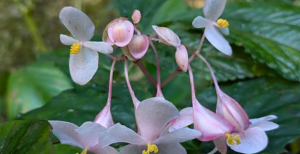
This plant stands out due to its pale pink flowers and dark green leaves that have a distinctive corrugated texture on their undersides. The female flowers droop noticeably, and the ovary wings are nearly equal in size, features that help distinguish it from other Begonia species. Currently, it is known only from this single location in Upper Siang.
Key Characteristics of Begonia siangensis and Related Species
- Flower Structure: Begonia plants are monoecious, meaning they bear separate male and female flowers on the same individual. Female flowers have an inferior ovary, positioned below the other floral parts.
- Fruit and Seed Production: Most Begonia species produce winged capsules filled with numerous tiny seeds, although some species also bear berry-like fruits.
- Growth Habits: Wild Begonias typically grow as terrestrial herbs or small shrubs. Some species are epiphytic, growing on other plants. They thrive in subtropical and tropical moist environments.
Why Discovering Begonia siangensis Matters
Finding a new plant species in Arunachal Pradesh underscores the region’s rich and largely unexplored biodiversity. The discovery of Begonia siangensis adds to the scientific understanding of the genus Begonia, which is known for its diversity and ecological importance. However, because the species is currently known from only one site, it has been classified as Data Deficient by the International Union for Conservation of Nature (IUCN). This classification means there is not enough information to assess its risk of extinction.
Experts emphasize the need for additional surveys in the area to determine the plant’s distribution, population size, and potential threats. Such research is crucial for conservation planning and ensuring that this unique species is protected amid increasing environmental pressures.
Frequently Asked Questions
Q: What makes Begonia siangensis different from other Begonias?
A: Begonia siangensis is distinguished by its pale pink flowers, dark green leaves with corrugated undersides, drooping female flowers, and nearly equal-sized ovary wings, features that are unique within its genus.
Q: Why is Begonia siangensis classified as Data Deficient?
A: It is classified as Data Deficient because it has only been found in one location, and there is insufficient information about its population size and distribution to determine its conservation status.
Q: What kind of environment does Begonia siangensis grow in?
A: This species grows beside shaded, moisture-rich mountain streams at mid-elevations around 600 meters, in the subtropical climate of Arunachal Pradesh’s Upper Siang district.