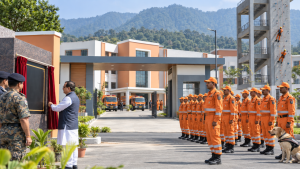
On November 22, 2026, Union Home Minister Amit Shah officially opened the new campus of the National Disaster Response Force’s (NDRF) 12th Battalion at Hollongi, near Itanagar in Arunachal Pradesh. This facility is designed to strengthen disaster response capabilities across Arunachal Pradesh and the broader Northeastern region of India.
Building a Regional Disaster Response Hub
The newly inaugurated campus is set to function as a central hub for disaster response and training, not only for Arunachal Pradesh but also for the neighboring Northeastern states. It aims to provide specialized training to State Disaster Response Forces (SDRF) from all eight Northeastern states, enhancing their preparedness for various emergencies.
All buildings on the campus have been constructed to meet earthquake-resistant standards, reflecting the region’s vulnerability to seismic activity. Among the campus’s notable features is an Olympic-size swimming pool equipped with a diving tank. This pool will be accessible free of charge to local swimmers and athletes from Itanagar and across Arunachal Pradesh, promoting community engagement alongside disaster preparedness.
Key Highlights and Event Details
- The inauguration was attended by prominent officials including Arunachal Pradesh Chief Minister Pema Khandu, Union Minister Kiren Rijiju, Home Secretary Govind Mohan, Intelligence Bureau Director Mahesh Dikshit, and NDRF Director General Piyush Anand.
- Alongside the campus opening, Amit Shah launched the Arunachal Pradesh Cooperative Vision Document 2027, outlining future cooperative development goals for the state.
- The Saras Mela, a cultural and trade fair, was also inaugurated during the event, highlighting the state’s rich traditions and economic potential.
Why This Campus Matters for Disaster Preparedness
The establishment of the 12th Battalion campus marks a significant step in enhancing disaster management infrastructure in a region prone to natural calamities such as floods, earthquakes, and landslides. The NDRF operates with a paramilitary structure, drawing personnel from India’s central armed police forces, which equips it with disciplined and skilled responders.
Each NDRF battalion can deploy 18 specialized search-and-rescue teams. These teams include engineers, technicians, electricians, dog squads, and medical personnel trained to handle complex rescue operations. The unified training syllabus shared between NDRF battalions and state responders ensures seamless coordination during large-scale disasters.
Training at the new campus will cover critical areas such as flood and rope rescue, collapsed structure search operations, medical first response, and handling nuclear, biological, and chemical emergencies. This comprehensive approach prepares responders to tackle a wide range of disaster scenarios effectively.
Frequently Asked Questions
Q: What is the role of the NDRF’s 12th Battalion campus?
A: The campus serves as a disaster response and training center for Arunachal Pradesh and the Northeastern states, providing specialized training to improve emergency preparedness and response.
Q: Who attended the inauguration of the campus?
A: The event was attended by Union Home Minister Amit Shah, Arunachal Pradesh Chief Minister Pema Khandu, Union Minister Kiren Rijiju, Home Secretary Govind Mohan, Intelligence Bureau Director Mahesh Dikshit, and NDRF Director General Piyush Anand.
Q: What facilities does the new campus include?
A: The campus features earthquake-resistant buildings, an Olympic-size swimming pool with a diving tank open to the public, and training infrastructure for various disaster response disciplines.