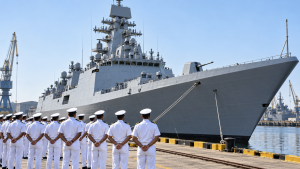
The Indian Navy received Vindhyagiri, the seventh and final frigate under the Project 17A programme, from Garden Reach Shipbuilders & Engineers Ltd (GRSE) at its Kolkata shipyard on 27 November 2026. Rear Admiral R.S. Dhaliwal formally accepted the 149-metre, 6,670-tonne guided-missile frigate on behalf of the Eastern Naval Command. The Navy plans to commission Vindhyagiri within the next two months, marking the completion of a significant indigenous warship construction effort.
Vindhyagiri is part of the Nilgiri-class frigates, which are the successors to the Shivalik-class Project 17 vessels. These ships are designed to enhance the Indian Navy's multi-dimensional warfare capabilities, incorporating stealth features, advanced weapons, and sensors. The Project 17A programme represents a ₹45,000-crore investment in strengthening maritime security through indigenous shipbuilding.
Seven Frigates Delivered in Less Than Two Years
The Project 17A fleet consists of seven frigates: four constructed by Mazagon Dock Shipbuilders Ltd (MDL) in Mumbai—INS Nilgiri, Udaygiri, Taragiri, and Mahendragiri—and three built by GRSE in Kolkata—Himgiri, Dunagiri, and Vindhyagiri. The delivery of all seven ships was completed within 23 months, beginning with INS Nilgiri's handover on 20 December 2024. This rapid production timeline underscores the Indian shipyards' growing capability and efficiency in warship construction.
Each frigate displaces approximately 6,670 tonnes and measures 149 metres in length. The ships boast about 75% indigenous content, reflecting India's push for self-reliance in defence manufacturing. President Droupadi Murmu inaugurated Vindhyagiri on 17 August 2023, highlighting the vessel's strategic importance.
Advanced Weaponry and Indigenous Systems on Vindhyagiri
Vindhyagiri is equipped with state-of-the-art weapon systems. It carries the BrahMos supersonic cruise missile, capable of striking surface and land targets with high precision. The BrahMos missile uses a two-stage propulsion system: a solid-propellant rocket motor for initial acceleration, followed by a liquid-fuelled ramjet engine that sustains supersonic speeds during cruise.
For air defence, Vindhyagiri is armed with the Barak-8 surface-to-air missile system. This missile employs a dual-pulse rocket motor, where the second pulse ignites during the terminal phase to enhance interception accuracy. The Barak-8 missiles are housed in vertical launch system (VLS) modules arranged in a 2x4 configuration, allowing rapid and flexible deployment against aerial threats. The ship's sensor suite includes an Active Electronically Scanned Array (AESA) radar, providing superior detection and tracking capabilities.
These advanced systems enable Vindhyagiri to perform a wide range of roles, including anti-aircraft, anti-submarine, and anti-surface warfare, making it a versatile asset for the Indian Navy's Eastern Command.
Strengthening India's Maritime Security Posture
The commissioning of Vindhyagiri completes a major chapter in India's naval modernization. The Project 17A frigates enhance the Navy's ability to safeguard India's maritime interests in the Indian Ocean Region and beyond. Their stealth features reduce radar cross-section, improving survivability in hostile environments. The indigenous design and construction also contribute to strategic autonomy by reducing dependency on foreign suppliers.
Rear Admiral R.S. Dhaliwal emphasized the significance of Vindhyagiri's induction, stating, "The addition of Vindhyagiri bolsters our fleet's operational readiness and reflects the Navy's commitment to maintaining a credible deterrent and effective maritime presence." The ship is expected to join the Eastern Naval Command's fleet soon, contributing to regional stability and maritime security.