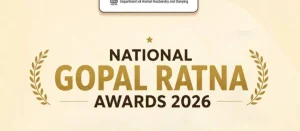
The Department of Animal Husbandry and Dairying, part of the Ministry of Fisheries, Animal Husbandry and Dairying, announced the winners of the National Gopal Ratna Awards 2026 on November 20. These awards celebrate outstanding contributions to the conservation, development, and promotion of indigenous bovine breeds in India.
Recognizing Excellence in Indigenous Bovine Conservation
The National Gopal Ratna Awards aim to encourage farmers, cooperatives, and organizations that work towards preserving native cattle breeds, which are vital to India’s agricultural heritage and rural economy. The awards highlight the importance of indigenous bovines, which are well adapted to local environments and play a crucial role in sustainable dairy farming.
Applications for the awards were accepted from August 10 to September 30, 2026, through the official government portal. A total of 1,583 entries were received, reflecting widespread participation from across the country.
Details of Award Categories and Winners
- The awards include categories such as Best Dairy Farmer and Best Dairy Cooperative Society, Milk Producer Company, or Dairy Farmer Producer Organization (FPO).
- In these categories, the top three winners receive cash prizes of ₹5 lakh for first place, ₹3 lakh for second, and ₹2 lakh for third.
- A Special Award of ₹2 lakh is also given to winners from the North Eastern Region (NER) and Himalayan States, recognizing the unique challenges and contributions of these areas.
- Muralidharan Nair from Kottayam, Kerala, earned first place in the Non-NER Best Dairy Farmer category.
- Sudhesh Kumar of Udham Singh Nagar, Uttarakhand, was honored with the Special Award for the NER/Himalayan region.
- The awards ceremony is scheduled for November 26, 2026, at Bapu Sabhagar in Muradpur, Patna, Bihar, coinciding with the National Milk Day celebrations.
- Union Minister Rajiv Ranjan Singh, also known as Lallan Singh, will present the awards.
How These Awards Support Indigenous Cattle Development
The National Gopal Ratna Awards are part of broader government efforts to strengthen indigenous cattle breeds through various initiatives. The Rashtriya Gokul Mission, for example, operates Gokul Gram cattle-care centers designed to increase populations of native bovines with superior genetics.
The Indian Council of Agricultural Research’s National Bureau of Animal Genetic Resources (ICAR-NBAGR) serves as the official registry for newly identified Indian livestock and poultry breeds, including indigenous cattle. This registry helps preserve genetic diversity and supports breeding programs.
Additionally, National Kamdhenu Breeding Centres function as advanced facilities focused on conserving and genetically improving indigenous cattle and buffalo germplasm. These centers employ modern reproductive technologies such as sex-sorted semen, in-vitro fertilization, and artificial insemination to accelerate genetic enhancement.
By recognizing exemplary farmers and organizations, the awards encourage the adoption of these advanced breeding techniques and promote sustainable dairy farming practices that benefit rural communities and the environment.
Frequently Asked Questions
Q: What is the purpose of the National Gopal Ratna Awards?
A: The awards recognize and encourage efforts to conserve, develop, and promote indigenous bovine breeds in India, supporting sustainable dairy farming and rural livelihoods.
Q: Who were the top winners of the 2026 awards?
A: Muralidharan Nair from Kerala won first place in the Non-NER Best Dairy Farmer category, while Sudhesh Kumar from Uttarakhand received a Special Award for the North Eastern Region and Himalayan States.
Q: When and where is the awards ceremony held?
A: The ceremony will take place on November 26, 2026, at Bapu Sabhagar, Muradpur, Patna, Bihar, as part of the National Milk Day celebrations.