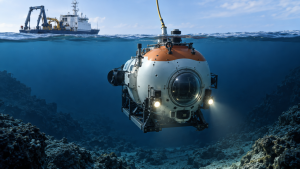
India’s deep-ocean submersible, Matsya-6000, is scheduled to undertake a significant 500-metre trial dive between January and February 2027. This milestone was confirmed by Srinivasa Kumar Tummala, Secretary of the Ministry of Earth Sciences, on November 13, 2026. The trial marks a crucial step toward the submersible’s ultimate goal: a crewed descent to depths of 6,000 metres as part of the ambitious Samudrayaan Project.
Development and Design of Matsya-6000
The Matsya-6000 is being developed by the National Institute of Ocean Technology (NIOT) under India’s Deep Ocean Mission, which aims to enhance the country’s capabilities in underwater exploration. The submersible features a spherical pressure hull with a diameter of 2.1 metres, designed to accommodate three people. It is engineered for missions lasting up to 12 hours, with an emergency life support system capable of sustaining occupants for 96 hours.
For the initial 500-metre trial dives, a steel sphere will be used to ensure safety and reliability during early testing phases. The final design intended for the full 6,000-metre dive involves a personnel sphere made from titanium alloy, also 2.1 metres in diameter but with an 80 mm thick hull capable of withstanding pressures up to 600 bar. This titanium sphere is being developed in collaboration with the Indian Space Research Organisation (ISRO), highlighting the interdisciplinary effort behind the project.
Two NIOT pilots, Ramesh Raju and Jatinder Pal Singh, are currently undergoing rigorous training to operate the submersible. The mission will also include a scientist onboard to conduct research during the dives.
Testing Progress and Mission Goals
Wet tests, which involve submerging the submersible in water to evaluate its performance and safety, were conducted during the week of November 6-12, 2026. Earlier tests had been completed by mid-September 2026 at Kattupalli Port near Chennai. These tests are essential to validate the submersible’s systems before the manned trial dives.
The broader objectives of the Matsya-6000 mission align with India’s Blue Economy vision, which focuses on sustainable use of ocean resources. The submersible will explore ocean biodiversity, conduct detailed surveys of the seabed, and assess mineral resources, particularly polymetallic nodules. These nodules are rich in valuable metals such as manganese, nickel, cobalt, copper, and iron hydroxide, which are critical for various industrial applications.
Significance of Deep-Sea Exploration for India
The Matsya-6000 project represents a major leap forward in India’s oceanographic research and underwater technology capabilities. Operating at depths up to 6,000 metres places the submersible in the abyssal zone, a region of the ocean floor that remains largely unexplored. Understanding this zone is vital for scientific knowledge, environmental monitoring, and resource management.
Internationally, the governance of seabed mineral resources beyond national jurisdictions falls under the International Seabed Authority, established by the United Nations Convention on the Law of the Sea (UNCLOS). India’s efforts to explore and potentially utilize these resources must comply with these international regulations, emphasizing responsible and sustainable ocean exploration.
The success of Matsya-6000’s trial dives will pave the way for crewed missions that could unlock new scientific discoveries and contribute to India’s strategic interests in the deep ocean.
Frequently Asked Questions
Q: What is the Samudrayaan Project?
A: The Samudrayaan Project is an Indian initiative aimed at developing deep-sea submersible technology to explore ocean depths up to 6,000 metres. It focuses on scientific research, resource assessment, and advancing underwater technology.
Q: Why is the titanium alloy used for the submersible’s hull?
A: Titanium alloy is chosen for its high strength-to-weight ratio and excellent resistance to corrosion and pressure, making it ideal for withstanding the extreme conditions at depths of 6,000 metres.
Q: What are polymetallic nodules and why are they important?
A: Polymetallic nodules are mineral deposits found on the ocean floor containing metals like manganese, nickel, cobalt, copper, and iron hydroxide. They are valuable for industrial uses and are a key focus of deep-sea mining research.