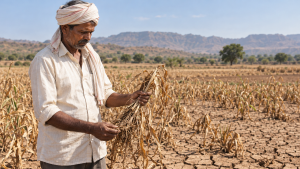
On November 17, 2026, the Maharashtra government officially added four talukas to its drought-hit list, increasing the number of affected subdistricts to 308 out of the state's 358 talukas. The newly included areas are Chiplun, Wada, and Vikramgad in the Konkan region, along with Dindori in Nashik district. This announcement came after a detailed survey and concerns raised by local elected officials about severe water scarcity and crop damage.
Understanding Maharashtra's Drought Situation
Maharashtra, a large state in western India, is divided into administrative units called talukas, which are subdivisions of districts. These talukas often face varying climatic and agricultural challenges. Drought in this context refers to a significant moisture deficit impacting rainfall, water flows, storage, or the availability of moisture to plants, leading to agricultural distress and water shortages for communities.
With 308 talukas now officially drought-affected, the crisis touches nearly the entire state. The regions of Vidarbha and Marathwada have been particularly vulnerable in recent years, facing repeated dry spells and crop failures. The government’s classification helps prioritize relief efforts and resource allocation to the worst-hit areas.
Key Details on Relief and Assessment Efforts
- The four new talukas added are Chiplun, Wada, Vikramgad (all in Konkan), and Dindori (Nashik district).
- Surveys are underway in nine additional talukas, including Hatkanangale, Kagal, Karveer, and Gadhinglaj in Kolhapur district, as well as Pen and Mahad in Raigad district.
- Guardian secretaries have been tasked with conducting district-level surveys and submitting reports before the upcoming winter Assembly session.
- Financial aid totaling ₹4,701.6 crore has been distributed to 94.3 lakh farmers across Maharashtra.
- Chhatrapati Sambhajinagar division received the highest allocation of ₹1,704.5 crore, followed by Nashik with ₹1,001.2 crore, Pune ₹788 crore, Amravati ₹765.8 crore, Nagpur ₹406.2 crore, and Konkan ₹35.9 crore.
- A new Government Resolution is expected to outline ten measures to combat drinking water shortages.
- Water conservation initiatives will follow the Shirpur model, replacing the existing ₹5,000-crore plan with a new strategy focused on drought-affected talukas, especially in Vidarbha and Marathwada.
- District authorities are promoting drought-resilient crops like maize and jowar under the VB-G RAM G scheme to alleviate fodder shortages for livestock.
Why Expanding the Drought List Matters for Maharashtra
Adding more talukas to the drought list signals the severity and spread of water scarcity across Maharashtra. This classification triggers access to government funds and relief programs designed to support farmers and communities facing crop failures and drinking water shortages. The financial assistance already disbursed aims to help farmers manage losses and sustain livelihoods during this challenging period.
The shift to a more targeted water conservation plan reflects lessons learned from past drought responses. The Shirpur pattern, known for its effective watershed management and groundwater recharge techniques, will guide new efforts to improve water availability. Prioritizing drought-hit areas ensures that resources are directed where they are most needed, potentially mitigating the impact of future dry spells.
Encouraging cultivation of drought-resistant crops like maize and jowar also helps farmers adapt to changing climate conditions and reduces dependency on water-intensive crops. These measures collectively aim to build resilience in Maharashtra’s agricultural sector and rural communities.
Frequently Asked Questions
Q: What is a taluka in Maharashtra?
A taluka is an administrative subdivision within a district, consisting of multiple towns and villages, and serves as a local governance unit.
Q: How does the government decide which talukas are drought-affected?
The government conducts surveys assessing rainfall, water flow, storage, and soil moisture levels to determine drought status based on moisture deficits impacting agriculture and water supply.
Q: What relief measures are provided to drought-affected farmers?
Farmers receive financial assistance, support for drought-resistant crops, and access to water conservation programs aimed at improving water availability and reducing crop losses.