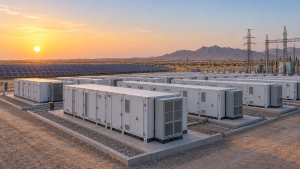
On November 25, 2026, Larsen & Toubro (L&T) announced it has secured an order to develop a 300 MW/900 MWh Battery Energy Storage System (BESS) at Khavda in Gujarat. This project, undertaken by L&T's Renewables and Electronic Products & Systems divisions, aims to store surplus renewable energy and dispatch it during peak demand periods, thereby stabilizing the regional power grid.
Battery energy storage systems are critical for integrating variable renewable energy sources like solar and wind into the electricity grid. L&T’s project at Khavda will use advanced liquid-cooling technology, which offers higher power density, enhanced safety, and a longer operational lifespan compared to traditional battery systems. The company classified this order as “significant,” indicating a contract value between ₹1,000 crore and ₹2,500 crore.
Technical Aspects of L&T’s Battery Storage System
The 300 MW/900 MWh system is designed to provide three hours of rated discharge duration, meaning it can deliver 300 MW continuously for three hours. This duration is vital for managing fluctuations in renewable energy generation and meeting peak electricity demand. The liquid-cooling technology improves thermal management, reducing the risk of overheating and extending battery life.
Battery storage systems like this can transition from standby mode to full power output in under a second. This rapid response capability helps grid operators manage sudden contingencies and maintain grid stability. Since batteries store direct current (DC) but the grid operates on alternating current (AC), the system will include inverters to convert stored DC power to AC before feeding it into the grid.
Khavda’s Growing Role in Renewable Energy Storage
Khavda has become a hub for large-scale battery storage projects. Earlier in 2026, Adani Green Energy Ltd commissioned 3.37 GWh of battery storage capacity at the same site, marking the world’s largest single-location battery storage project outside China. Completed in just 10 months, this facility had expanded to 6.63 GWh by October 1, 2026.
Adani plans to add over 10 GWh of battery storage capacity during the fiscal year 2027 and aims to scale the Khavda Renewable Energy Park’s capacity to 50 GWh within the next five years. The addition of L&T’s 900 MWh system will further bolster Khavda’s status as a strategic energy storage hub, supporting India’s renewable energy targets and grid reliability.
By situating battery storage plants adjacent to operating or retired power stations, developers can share grid connection infrastructure, lowering costs and streamlining integration. This approach is being applied at Khavda, where multiple large-scale storage projects coexist to maximize efficiency.
The development of such battery energy storage systems is crucial for India’s transition to a cleaner energy future. They enable better management of renewable energy variability, reduce reliance on fossil fuel peaking plants, and support the stability of the national grid as renewable capacity expands rapidly.