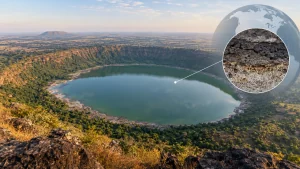
Lonar Lake, located in Maharashtra’s Buldhana district, has been officially recognized as one of the world’s significant geological sites by the International Union of Geological Sciences (IUGS). This announcement was confirmed by India’s Ministry of Mines on November 13, 2026, marking a notable achievement for the region and the country’s geological community.
The inclusion of Lonar Lake in the “Third 100 IUGS Geological Heritage Sites” list underscores its global scientific value and unique natural history. This recognition is expected to boost research, education, and tourism in the area, while promoting conservation efforts.
What Makes Lonar Lake Geologically Unique?
Lonar Lake is a rare example of a hypervelocity meteorite-impact crater formed in basalt rock. Measuring approximately 1.88 kilometers in diameter, the crater is estimated to be around 12,000 years old. It is situated within the Deccan Traps, a vast expanse of volcanic basalt formations created roughly 65 million years ago.
Only five such impact craters on Earth are known to have formed in basalt, making Lonar Lake an exceptional site for geological study. The crater’s formation was initially mistaken for volcanic activity, but subsequent investigations confirmed its impact origin through evidence such as shatter cones and maskelynite found in drill cores beneath the lake floor.
Key Facts About Lonar Lake’s Geological Significance
- Impact Evidence: Drill cores reveal coarse breccia with shatter cones and maskelynite, indicating shock metamorphism caused by the meteorite impact.
- Lake Chemistry: The lake is saline and highly alkaline, situated in an endorheic basin where water does not drain out.
- Scientific Recognition: The Geological Survey of India nominated Lonar Lake, which received preliminary approval at the IUGS Executive Committee meeting in Bogotá, Colombia, in January 2026.
- Previous Indian Site: Lonar is India’s second site on the IUGS heritage list, following Meghalaya’s Mawmluh Cave, added in 2022.
Why Lonar Lake’s Inclusion Matters
Being listed as an IUGS Geological Heritage Site elevates Lonar Lake’s profile on the global stage, attracting attention from scientists, educators, and tourists alike. This status helps ensure the site’s protection and encourages further geological research, which can provide insights into meteorite impacts and Earth’s geological history.
For the local region of Buldhana and the broader Vidarbha area, this recognition may lead to increased tourism, fostering economic benefits while emphasizing sustainable preservation. Educational programs can also leverage this status to raise awareness about Earth sciences and the importance of conserving natural heritage sites.
Frequently Asked Questions
Q: What is the International Union of Geological Sciences (IUGS)?
A: The IUGS is a global organization dedicated to promoting and coordinating geological research and education. It identifies and recognizes sites of significant geological importance worldwide.
Q: How old is Lonar Lake?
A: Lonar Lake is estimated to be about 12,000 years old, formed by a meteorite impact during that period.
Q: Why is Lonar Lake considered rare?
A: It is one of only five known hypervelocity meteorite-impact craters on Earth formed in basalt rock, making it a unique geological feature.