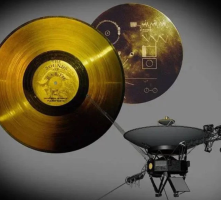
On November 18, 2026, NASA’s Voyager 1 spacecraft reached a distance of one light-day from Earth, approximately 25.9 billion kilometers away. Among the treasures it carries is a recording of the renowned Indian classical singer Kesarbai Kerkar, whose voice has been traveling through space for nearly five decades.
The Story Behind Kesarbai Kerkar’s Recording
Kesarbai Kerkar’s performance of "Jaat Kahan Ho" in Raga Bhairavi was recorded in Bombay in April 1953. This three-and-a-half-minute piece was selected as the only Indian classical music track included on the Voyager Golden Record, a phonograph record attached to both Voyager 1 and Voyager 2 spacecraft launched in 1977. Ethnomusicologist Robert E. Brown praised this recording as one of the finest examples of Indian classical music ever captured.
Kerkar was born in July 1892 in Keri, Goa, and passed away on September 16, 1977, shortly after Voyager 1’s launch. Her voice now journeys far beyond Earth, symbolizing a cultural message sent to any potential extraterrestrial listeners.
What Is the Voyager Golden Record?
The Voyager Golden Record is a 12-inch gold-plated copper disc designed to communicate the diversity of life and culture on Earth to any intelligent beings that might find it. Curated by a team led by astronomer Carl Sagan, the record contains 115 images, natural sounds such as wind and thunder, and about 90 minutes of music from around the world.
In addition to Kerkar’s Indian classical music, the record features greetings in 55 languages, including ten Indian languages: Hindi, Bengali, Marathi, Gujarati, Kannada, Telugu, Punjabi, Urdu, Oriya, and Rajasthani. The goal was to present a snapshot of humanity’s cultural richness and scientific knowledge.
Technical Details of the Golden Record
- Durability: The record uses a grooved metal phonograph format, chosen because it was expected to last longer in space than magnetic tape.
- Age Indicator: Its aluminum cover contains uranium-238, which helps future finders estimate the record’s age based on radioactive decay.
- Image Encoding: Images are stored in an analog format with 512 vertical lines, intended to be reconstructed from the recorded signals.
- Time Reference: The record’s rotation speed is encoded in binary using the hydrogen atom’s transition period, providing a universal time standard.
Why Kesarbai Kerkar’s Voice Matters in Space Exploration
The inclusion of Kesarbai Kerkar’s music on the Voyager Golden Record highlights the importance of cultural diversity in humanity’s message to the cosmos. Her voice represents not only Indian classical music but also the broader human experience, preserved beyond our planet. As Voyager 1 continues its journey into interstellar space, Kerkar’s recording remains a poignant reminder of Earth’s artistic heritage.
This unique blend of science and culture aboard Voyager 1 underscores the mission’s ambition: to reach beyond the stars and share a piece of humanity with the universe.
Frequently Asked Questions
Q: What is the Voyager Golden Record?
A: It is a gold-plated copper disc attached to the Voyager spacecraft, containing sounds and images representing life and culture on Earth, intended for any extraterrestrial intelligence that might find it.
Q: Why was Kesarbai Kerkar’s music included on the record?
A: Her recording of "Jaat Kahan Ho" in Raga Bhairavi was selected as an exemplary piece of Indian classical music, showcasing the richness of Earth’s musical traditions.
Q: How does the Golden Record communicate its age and playback instructions?
A: The record’s cover includes uranium-238 to help determine its age through radioactive decay, and it encodes playback speed using the hydrogen atom’s transition period as a universal time reference.