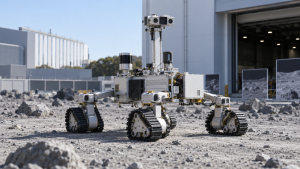
Japan Aerospace Exploration Agency (JAXA) revealed a prototype rover for the Chandrayaan-5/LUPEX mission on November 25, 2026, at its Chofu Aerospace Centre. This rover demonstration showcased its ability to traverse simulated lunar terrain using caterpillar tracks mounted on four articulated legs. The unveiling marks a significant milestone in the collaborative lunar mission between JAXA and the Indian Space Research Organisation (ISRO).
The Chandrayaan-5/LUPEX mission, scheduled for launch no earlier than 2028 aboard Japan's H3-24L launch vehicle, aims to explore the Moon’s south pole, focusing on permanently shadowed regions where water-ice deposits are believed to exist. The Union government of India granted financial sanction to the mission on March 10, 2025, underscoring the strategic importance of this joint venture.
Joint Efforts in Lunar Exploration
This mission is the fifth installment in the Chandrayaan series and represents a deepening partnership between Japan and India in space exploration. JAXA is responsible for developing the rover and the launch vehicle, while ISRO is tasked with building the lunar lander and contributing several scientific instruments. The rover itself is designed to conduct detailed scientific investigations on the lunar surface, particularly focusing on the detection and analysis of lunar volatiles such as water-ice.
One of the rover's key instruments is NASA’s Neutron Spectrometer, which will search for subsurface water deposits by detecting neutrons emitted from the lunar surface. Additionally, the European Space Agency’s Exploration Mass Spectrometer for LUPEX will analyze the Moon’s extremely tenuous exosphere, providing insights into the composition and dynamics of the lunar atmosphere.
Technical Innovations and Mission Challenges
The rover’s design incorporates continuous caterpillar tracks that distribute its weight more evenly than traditional wheels. This design reduces the risk of the rover sinking into soft lunar soil, a critical feature given the Moon's challenging terrain. These tracks may be constructed from steel-reinforced synthetic-rubber belts, offering durability and flexibility essential for navigating uneven surfaces.
Landing on the Moon presents unique challenges due to the absence of an atmosphere, which means the lander must rely entirely on propulsion systems to decelerate and achieve a soft touchdown. The mission also has to address the Moon’s prolonged day-night cycle, which complicates solar power management. To sustain operations over lunar nights lasting approximately 14 Earth days, the rover will require energy storage solutions or hibernation capabilities.
Beyond immediate scientific goals, the mission seeks to evaluate the feasibility of using lunar water as rocket fuel, a crucial step toward sustainable human presence on the Moon and future deep-space missions. Chandrayaan-5/LUPEX is also considered a precursor to a more ambitious lunar sample-return mission, which would bring back Moon materials for detailed analysis on Earth.
The unveiling of this rover prototype demonstrates tangible progress in international cooperation for lunar exploration, combining technological expertise from Japan, India, the United States, and Europe. As the mission progresses toward its planned launch, it promises to expand our understanding of the Moon’s resources and environment, potentially paving the way for humanity’s next giant leap in space.