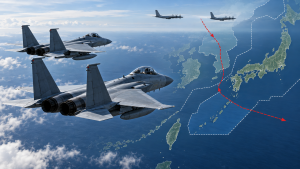
On November 17, 2026, Japan scrambled fighter jets in response to two suspected Russian aircraft entering its airspace near Okinoshima, off the coast of Fukuoka. The first aircraft was detected at approximately 4:07 a.m. local time and remained in Japanese airspace for about three minutes before continuing on its route.
Details of the Airspace Incursion
The Japan Air Self-Defense Force (JASDF) quickly dispatched jets to intercept and warn the intruding aircraft. Chief Cabinet Secretary Minoru Kihara described the incident as a serious violation of Japan’s sovereignty, calling it "completely unacceptable." In response, Tokyo issued a "very stern protest" to Moscow through diplomatic channels, demanding measures to prevent similar incidents in the future.
The suspected Russian planes flew through the Tsushima Strait, passing between Yonaguni Island in Okinawa Prefecture and Taiwan, before heading out over the Pacific Ocean. Reports vary on the timing of previous Russian incursions, with some sources citing September 2024 as the last confirmed breach, while others note that the 2024 incident was the first since 2019.
Understanding Air Defense Identification Zones and Regional Responses
On the same day, South Korea also responded to Russian military aircraft entering its Korea Air Defense Identification Zone (KADIZ) over the East Sea, also known as the Sea of Japan. Although the aircraft did not enter South Korean sovereign airspace, the country deployed fighter jets and conducted tactical maneuvers as a precaution. The KADIZ is a designated area where countries monitor and identify aircraft approaching their airspace, but it is not legally recognized as sovereign territory under international law.
An air defense identification zone (ADIZ) is a unilateral declaration by a country to extend its radar coverage beyond its borders, providing extra time to detect and respond to potential threats. Unlike sovereign airspace, which is protected by international law, ADIZs are not formally recognized by international treaties or organizations.
Japan’s Air Defense Capabilities and Regional Security Implications
Japan’s air defense system integrates radar installations and air-defense direction centers nationwide through the Basic Air Defense Ground Environment. This network allows the JASDF to monitor airspace comprehensively and respond swiftly to incursions. Additionally, Japan’s four regional headquarters coordinate with Ground Self-Defense Force surface-to-air missile units to strengthen regional missile defense capabilities.
The recent incident underscores ongoing tensions in Northeast Asia, where airspace violations and military maneuvers have increased amid broader geopolitical rivalries. Japan’s firm response signals its commitment to protecting national sovereignty and maintaining regional security amid these challenges.
Frequently Asked Questions
Q: What is an air defense identification zone (ADIZ)?
A: An ADIZ is a designated area beyond a country's sovereign airspace where it monitors and identifies approaching aircraft. It is declared unilaterally and is not recognized as sovereign territory under international law.
Q: How did Japan respond to the suspected Russian airspace incursion?
A: Japan scrambled fighter jets to warn the aircraft, condemned the violation as a serious breach of sovereignty, and lodged a stern diplomatic protest with Russia.
Q: Did the Russian aircraft enter South Korean airspace as well?
A: No, the Russian planes entered South Korea's air defense identification zone but did not cross into South Korean sovereign airspace. South Korea still deployed jets as a precaution.