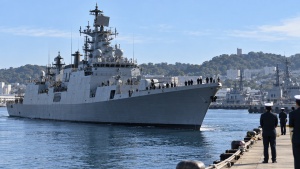
India’s indigenous guided-missile stealth frigate INS Sahyadri left Yokosuka Naval Base in Japan on November 12, 2026, following its participation in the MALABAR 2026 naval exercise. The ship had arrived at the base on November 4 to take part in the week-long drills.
The MALABAR 2026 Naval Exercise
MALABAR 2026 was held from November 5 to 12 and brought together naval forces from India, Japan, the United States, and Australia. This marked the 30th anniversary of the exercise and the sixth time all four Quad nations participated together. The exercise included both Harbour and Sea Phases, focusing on enhancing operational coordination, interoperability, and professional expertise among the participating navies.
During the Sea Phase, the navies conducted a variety of complex drills such as Anti-Submarine Warfare operations, Visit, Board, Search and Seizure (VBSS) exercises, Maritime Interdiction Operations, gunnery practice, replenishment approaches, and cross-deck helicopter landings. These activities aimed to improve joint operational capabilities and readiness in the Indo-Pacific maritime domain.
Ships and Nations Involved
The exercise featured several key naval vessels from the participating countries. India was represented by INS Sahyadri, a Shivalik-class stealth multi-role frigate. Japan contributed its helicopter destroyer JS Ise and frigate JS Mogami. Australia sent its frigate HMAS Stuart, while the United States deployed amphibious transport docks USS Anchorage and USS John P. Murtha.
The collaboration during MALABAR 2026 reaffirmed the commitment of these navies to maritime cooperation and collective security in the Indo-Pacific region. This aligns with India’s MAHASAGAR vision, which emphasizes strengthening maritime partnerships and ensuring peace and stability in the region.
Significance of INS Sahyadri and MALABAR Exercise
INS Sahyadri belongs to the Shivalik class of frigates, which are known for their stealth features and multi-role capabilities. These frigates represent a significant advancement over the earlier Talwar-class ships, offering improved stealth and enhanced land-attack options. The participation of such advanced vessels highlights India’s growing naval capabilities and its strategic role in regional security.
Exercise MALABAR began in 1992 as a bilateral naval exercise between India and the United States. Over the years, it has evolved into a major multilateral exercise involving key Indo-Pacific partners. The inclusion of Japan and Australia reflects the expanding scope of cooperation among Quad nations to address shared maritime challenges.
The successful completion of MALABAR 2026 demonstrates the increasing interoperability among these navies, which is crucial for coordinated responses to regional threats such as piracy, maritime terrorism, and ensuring freedom of navigation.
Frequently Asked Questions
Q: What is the purpose of Exercise MALABAR?
A: Exercise MALABAR aims to enhance naval cooperation, interoperability, and operational readiness among participating countries to promote maritime security in the Indo-Pacific region.
Q: What type of ship is INS Sahyadri?
A: INS Sahyadri is a Shivalik-class guided-missile stealth frigate designed for multi-role operations including anti-submarine, anti-air, and land-attack missions.
Q: Which countries participate in the MALABAR exercise?
A: The exercise currently involves India, Japan, the United States, and Australia, all members of the Quad grouping focused on regional security cooperation.