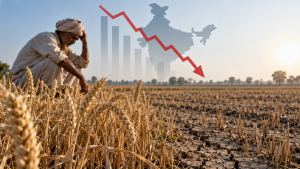
India’s wheat planting area for the 2026/27 season is projected to shrink by nearly 6% compared to the previous year’s record high of 33.6 million hectares. This decline, forecasted at 31.58 million hectares, would be the smallest wheat area in four years and the largest drop since the 2000/01 season, according to a November 20, 2026 report.
Why Wheat Area Is Shrinking
Several factors are contributing to this significant reduction in wheat cultivation. One of the main reasons is the unusually low monsoon rainfall between June and September 2026, which was the lowest in over a decade. States like Punjab, Rajasthan, Madhya Pradesh, and Maharashtra experienced rainfall deficits as high as 41% below average. This lack of moisture has made it difficult for farmers to sow and irrigate wheat crops effectively.
By mid-November, wheat sowing had covered only about 5 million hectares, a 15.3% decrease compared to the same time last year. Many farmers are responding to water shortages by switching to crops that require less water, such as chickpeas and rapeseed. For example, a farmer in Maharashtra’s Jalna district reported abandoning wheat cultivation in favor of chickpeas due to insufficient water availability.
Key Facts About Wheat Cultivation and Support
- The government increased the minimum support price (MSP) for wheat by just 1% to ₹2,610 per 100 kilograms, the smallest hike since 2002/03.
- Wheat awns, the bristle-like structures on the grain, are more efficient at photosynthesis under drought conditions than leaves, making them common in varieties grown in hot, dry areas.
- The Commission for Agricultural Costs and Prices recommends MSPs, but the Cabinet Committee on Economic Affairs has the final say on price decisions.
- For irrigated wheat, the critical stage for watering is about 20 to 25 days after sowing during crown-root initiation; moisture stress at this time can harm root development and reduce yields.
- Bread wheat is hexaploid, containing three sets of genomes (A, B, and D), while durum wheat, used mainly for pasta, is tetraploid.
What This Decline Means for Indian Agriculture
The drop in wheat planting area reflects broader challenges facing Indian farmers, including climate variability and water scarcity. Wheat is a staple food crop and a key part of India’s food security strategy. Reduced cultivation could affect domestic wheat production and potentially lead to higher prices or increased imports if demand remains steady.
The modest increase in the MSP may not be enough to incentivize farmers to maintain or expand wheat cultivation, especially when water-intensive crops become riskier to grow. This situation could accelerate shifts toward more drought-tolerant crops, altering cropping patterns in major wheat-growing regions.
States like Punjab and Haryana, which rely heavily on irrigation, are expected to maintain their wheat acreage, but rain-fed areas are likely to see the biggest reductions. The government and agricultural experts will need to monitor these trends closely to support farmers and ensure stable food supplies.
Frequently Asked Questions
Q: Why is India’s wheat planting area expected to decline in 2026?
A: The decline is mainly due to the lowest monsoon rainfall in over a decade, causing water shortages that make wheat cultivation more difficult, especially in rain-fed regions.
Q: How much has the government increased the minimum support price for wheat?
A: The government raised the minimum support price by 1% to ₹2,610 per 100 kilograms, the smallest increase since 2002/03.
Q: Are all regions in India reducing wheat planting?
A: No, irrigated regions like Punjab and Haryana are expected to keep their wheat acreage steady, while rain-fed areas such as parts of Maharashtra and Rajasthan are reducing wheat cultivation in favor of less water-intensive crops.