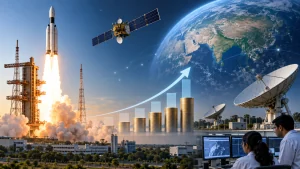
India’s space economy, currently valued at nearly USD 9 billion as of August 2026, is expected to expand rapidly to reach between USD 40 and 45 billion by the end of this decade. Union Minister of State Dr. Jitendra Singh announced this projection during the India International Space Conclave 2026 held in New Delhi on November 24.
Dr. Singh highlighted that this growth is propelled by a vibrant private sector, which has grown from just a few startups to nearly 400–500 companies actively engaged in the space ecosystem. He credited the expansion to increased private investment, entrepreneurship, and the development of indigenous technology, supported by government reforms that have opened the sector to private participation.
Government Initiatives and Private Sector Momentum
The government reforms mentioned by Dr. Singh include the establishment of NewSpace India Limited and the Indian National Space Promotion and Authorization Center (IN-SPACe). These bodies facilitate private sector involvement by providing authorizations and support for satellite operations, payload development, and launch services.
According to a report by Jefferies, which cites government estimates, the Indian space economy was worth approximately USD 8.4 billion in 2023. The report forecasts a growth trajectory reaching USD 40–45 billion by 2030, with potential to hit USD 100 billion by 2040 if current trends continue.
Private investment in the sector has surged significantly, rising from USD 100.5 million in fiscal year 2021–22 to USD 618.5 million by March 31, 2026. Notably, USD 187 million of this investment was recorded in 2026 alone, underscoring accelerating confidence among investors.
IN-SPACe has played a pivotal role in enabling this growth by granting 113 authorizations to 52 non-government entities, including 18 startups, by mid-2026. These authorizations cover satellite operations, payload establishment, and launch services, reflecting a broadening of the space ecosystem beyond traditional government agencies.
NewSpace India Limited’s Role in Industry Collaboration
NewSpace India Limited (NSIL), a government-owned public sector undertaking under the Department of Space, acts as a key facilitator in the commercialization of space technology. NSIL collaborates with industry partners to produce, assemble, and integrate launch vehicles through an industrial consortium, involving multiple stakeholders in vehicle realization.
Additionally, NSIL manages technology transfer processes, obtaining licenses from the Department of Space or ISRO and sublicensing small-satellite technologies to private industry players. This mechanism accelerates the development of indigenous capabilities and supports the growth of startups and private companies in the space sector.
The India International Space Conclave 2026 also witnessed the launch of the "Space Economy 2036: The India Blueprint" report, outlining strategic plans to sustain and enhance the growth trajectory of India’s space economy over the next decade and beyond.
With these developments, India is positioning itself as a major player in the global space economy, leveraging policy reforms, private sector dynamism, and technological innovation to achieve ambitious growth targets.