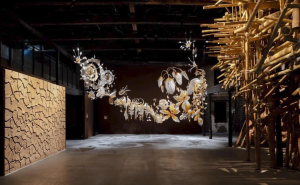
India’s national pavilion secured the prestigious Visitors’ Lion award for Best National Participation at the 61st International Art Exhibition of La Biennale di Venezia, held in Venice, Italy. The announcement came on 25 November 2026, shortly after the exhibition concluded. This accolade marks a significant achievement for India, especially as it marked the country’s return to the Biennale after a seven-year hiatus.
The exhibition, titled “In Minor Keys,” ran from 9 May to 22 November 2026, attracting 714,015 visitors. This attendance figure is the second-highest in the history of the Biennale, despite the event running three weeks shorter than previous editions. The exhibition featured participation from 100 countries, each presenting their national pavilions.
India’s Pavilion: "Geographies of Distance: Remembering Home"
India’s pavilion, named “Geographies of Distance: Remembering Home,” was curated by Amin Jaffer. It showcased works by artists Alwar Balasubramaniam, Sumakshi Singh, Ranjani Shettar, Asim Waqif, and Skarma Sonam Tashi. The pavilion was housed in the historic Isolotto spaces of the Arsenale di Venezia, a prominent venue within the Biennale complex.
The pavilion was presented through a collaboration between the Ministry of Culture and Tourism, the Nita Mukesh Ambani Cultural Centre, and Serendipity Arts. This partnership highlights India's commitment to promoting contemporary art on the global stage and reconnecting with the international art community after a long absence.
Visitors’ Lion: A New Chapter in Biennale Awards
The Visitors’ Lion award was introduced this year as a replacement for the traditional Golden and Silver Lions, which were previously selected by an international jury. This change came after the entire jury resigned on 30 April 2026, citing their refusal to consider countries whose leaders were charged with crimes against humanity by the International Criminal Court. This decision notably referenced Russia and Israel, leading to a significant shift in the Biennale’s award process.
Instead of a jury, ticket-holding visitors who toured both the Giardini and Arsenale venues voted for the recipients of the Visitors’ Lions. This new voting system gave the public a direct voice in recognizing outstanding contributions. Alongside India’s pavilion winning the Visitors’ Lion for Best National Participation, American artist Nick Cave received the Visitors’ Lion for Best Participant in the main exhibition.
Historical and Cultural Significance of National Pavilions
The tradition of national pavilions at the Venice Biennale dates back to 1907, when Belgium established the first pavilion. These pavilions allow countries to present their artistic narratives independently, with each nation appointing commissioners and selecting artists to represent their cultural identity rather than relying solely on the Biennale’s artistic director.
The Venice Biennale operates on a biennial cycle alternating between the International Art Exhibition and the International Architecture Exhibition, ensuring that each major event receives focused attention in different years. The festival also includes annual theatre, music, and dance events, while the Venice Film Festival takes place at the Lido.
India’s success at the 2026 Biennale not only underscores the country’s rich artistic heritage but also signals a renewed engagement with global contemporary art dialogues. The pavilion’s evocative theme, "Geographies of Distance: Remembering Home," resonated deeply with visitors, reflecting on themes of memory, displacement, and identity that are increasingly relevant in today’s world.