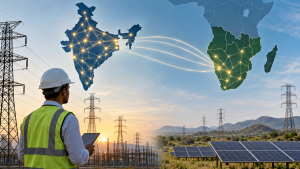
On November 27, 2026, Indian High Commissioner to South Africa Prabhat Kumar proposed adapting India’s One Grid cross-border electricity model for South Africa and its neighbouring countries Lesotho, Botswana, and Namibia. This suggestion came during the signing of a Memorandum of Understanding (MoU) between India’s National Power Training Institute (NPTI) and the Wits Business School at the University of the Witwatersrand in Johannesburg, aiming to deepen energy cooperation and capacity building.
Kumar emphasized that India’s existing grid system, which currently interconnects power supplies with Bhutan, Nepal, and Bangladesh, could serve as a blueprint for Southern Africa’s regional power integration. The One Grid initiative links countries to facilitate energy sharing, improve efficiency, and support renewable energy development across borders.
NPTI and Wits Business School Collaboration to Boost Energy Expertise
The MoU between NPTI and Wits Business School builds on the foundation laid by the inaugural Matla Urja Conference held two years prior. It focuses on joint programmes in energy education, training, research, and consultancy, particularly in renewable energy and energy efficiency. This partnership is expected to enhance the skills and knowledge base necessary for managing complex power systems in Southern Africa.
At the India-Africa Strategic Partnership Meet in New Delhi on March 21, 2026, Union Power Minister Manohar Lal described the One Sun, One World, One Grid initiative as a pathway toward global energy connectivity. This vision includes phased regional interconnections starting with the Middle East, South Asia, and Southeast Asia, eventually linking Asia and Africa, and ultimately achieving a worldwide grid.
Southern Africa’s Ambitious Transmission Expansion and Indian Involvement
South Africa launched a US$25 billion Independent Transmission Projects programme in October 2025 to construct 14,000 km of power lines aimed at strengthening the national and regional grid infrastructure. The programme seeks to attract private investment, with Indian companies such as DRA Infracon and Adani Power’s Middle East unit expressing interest in participating.
Africa50, a pan-African infrastructure investment platform, has highlighted India’s nearly 500 GW of installed electricity capacity and its One Nation, One Grid initiative as exemplary models for regional power development. Its collaboration with India’s Power Grid Corporation includes a transmission project in Kenya, underscoring growing India-Africa energy ties.
India’s cross-border grid infrastructure already connects India with Bhutan, Bangladesh, Nepal, and Myanmar, providing a ready framework that could be upgraded and adapted for Southern Africa’s needs. The proposed green grid focuses on solar and wind energy integration, aligning with international efforts led by the International Solar Alliance involving India, France, and the United Kingdom.
By sharing its experience and technology, India aims to support Southern Africa’s transition to a more interconnected and renewable energy-driven power system, which could enhance energy security, reduce costs, and promote sustainable development in the region.