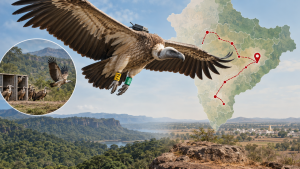
A seven-year-old female Indian vulture was observed in Ausa tehsil, Latur district, on November 18, 2026. This marked the first recorded sighting of the critically endangered species in the district. The bird, tagged F14/M99, had traveled an impressive 10,767 kilometers across Maharashtra, Madhya Pradesh, and Karnataka before arriving in Latur.
How the Vulture’s Journey Was Tracked
This Indian vulture was bred at the Bombay Natural History Society center located in Pinjore, Haryana. It was one of 15 vultures released earlier in 2026 into the Somthana forest range within the Melghat Tiger Reserve. Each bird was fitted with a satellite transmitter and colored leg bands to monitor their movements.
Tracking data revealed that the vulture’s journey began on May 28 and continued until November 20, covering over 10,700 kilometers. Its route took it through several locations in Maharashtra, including Akot, Malkapur, Nashik, Thane, and Pune. It then moved into Karnataka, reaching Vijayapura, before returning through Latur.
The bird was first spotted by wildlife enthusiast Abhijit Rasal. A team led by Deputy Conservator of Forests Amitraj Jadhav, along with wildlife observer Dhananjay Gutte and Dr. Datta Ambekar, later confirmed the bird’s identity by examining its leg bands. This sighting provides encouraging evidence that captive-bred vultures can survive in the wild and integrate with existing populations.
Key Facts About Indian Vultures and Conservation Efforts
- Species distinction: Until 2001, the slender-billed vulture was considered a subspecies of the Indian vulture. Genetic studies using nuclear and mitochondrial DNA later confirmed it as a separate species.
- Threat from veterinary drugs: The decline of Indian vultures has been largely attributed to diclofenac, a veterinary drug that causes fatal kidney failure in vultures when they consume treated livestock carcasses.
- Impact of diclofenac: Research indicates that diclofenac present in as little as 0.8% of livestock carcasses can lead to a dramatic collapse in vulture populations.
- Safer alternatives: Meloxicam has been proposed as a safer substitute for diclofenac because it is quickly metabolized and does not harm vultures.
Why This Sighting Matters for Conservation
The successful tracking and sighting of this captive-bred Indian vulture demonstrate that conservation efforts involving breeding and release programs can help restore wild populations. Indian vultures play a crucial ecological role by scavenging animal carcasses, which helps prevent the spread of diseases.
Their dramatic decline over recent decades has raised alarms among conservationists. The confirmation that released vultures can survive long-distance migrations and adapt to wild environments offers hope for reversing population declines.
This sighting also highlights the importance of continued monitoring and protection of vultures, as well as the need to eliminate harmful veterinary drugs like diclofenac from livestock treatment. Protecting these birds supports biodiversity and ecosystem health across the regions they inhabit.
Frequently Asked Questions
Q: Why are Indian vultures critically endangered?
A: Indian vultures have suffered severe population declines mainly due to poisoning from the veterinary drug diclofenac, which causes fatal kidney failure when vultures consume treated livestock carcasses.
Q: How do conservationists track vultures?
A: Vultures are often fitted with satellite transmitters and colored leg bands that allow researchers to monitor their movements and survival after release into the wild.
Q: What is being done to protect Indian vultures?
A: Conservation efforts include captive breeding and release programs, banning harmful drugs like diclofenac, promoting safer alternatives such as meloxicam, and habitat protection to support wild populations.