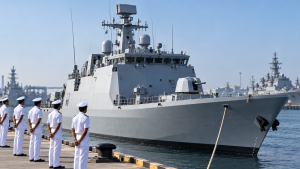
On November 23, 2026, the Indian Navy formally received the ASW-SWC Ashank, also known as Yard 3036, at Visakhapatnam. Rear Admiral Gautam Marwaha accepted the vessel on behalf of the Navy, marking a significant addition to India’s maritime defense capabilities.
Indigenous Design and Strategic Role of Ashank
Ashank is the sixth ship in the Arnala-class series of Anti-Submarine Warfare Shallow Water Crafts (ASW-SWC), designed and built by Garden Reach Shipbuilders and Engineers (GRSE) in Kolkata. This class of vessels is specifically tailored for operations in coastal and shallow waters, focusing on anti-submarine warfare, underwater surveillance, and mine-laying tasks.
With over 80 percent indigenous content, Ashank represents a major step in India’s push for self-reliance in defense manufacturing. The ship is equipped with lightweight torpedoes, indigenous rocket launchers, advanced sonar systems, and a 30 mm naval surface gun produced by GRSE. It is also one of the largest Indian naval warships powered by waterjet propulsion, which offers enhanced maneuverability in shallow waters.
Key Features and Technical Details of the Arnala-Class
- Fleet Deployment: Arnala-class vessels like Ashank are assigned to the Eastern Fleet, while Mahe-class ships serve the Western Fleet.
- Construction Method: These ships are built using integrated block construction, assembling 19 hull blocks manufactured at various locations.
- Propulsion System: Each vessel has three marine diesel engines driving individual waterjets through reversible reduction gears, enabling high agility.
- Stealth Capabilities: The design incorporates measures to reduce radar, acoustic, and infrared signatures, enhancing survivability during coastal missions.
Why Ashank’s Induction Strengthens Coastal Security
The addition of Ashank enhances the Indian Navy’s ability to monitor and protect its extensive coastline, especially in shallow and littoral zones where conventional larger ships may face operational challenges. Its advanced sonar and weapon systems improve detection and neutralization of underwater threats such as submarines and mines.
GRSE’s rapid delivery of Ashank, just 18 days after the previous vessel Amini, reflects the shipbuilder’s growing capacity and efficiency in producing sophisticated warships. With a total of 120 warships built, including 82 for the Indian Navy, GRSE plays a crucial role in modernizing India’s naval fleet.
As maritime security becomes increasingly vital in the Indo-Pacific region, vessels like Ashank contribute to safeguarding national interests and maintaining regional stability.
Frequently Asked Questions
Q: What is the primary mission of the ASW-SWC Ashank?
A: Ashank is designed for anti-submarine warfare, underwater and coastal surveillance, and mine-laying operations in shallow waters.
Q: Who built the Ashank and where?
A: The ship was indigenously designed and constructed by Garden Reach Shipbuilders and Engineers (GRSE) in Kolkata, India.
Q: What makes the Arnala-class vessels suitable for coastal defense?
A: Their waterjet propulsion provides enhanced maneuverability in shallow waters, and stealth features reduce detection by enemy sensors, making them effective for coastal operations.