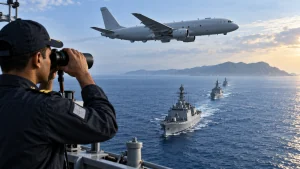
On November 18, 2026, the Indian Navy commemorated half a century of Long-Range Maritime Reconnaissance (LRMR) operations, coinciding with the anniversary of the Indian Naval Air Squadron (INAS) 312, famously known as the ‘Albatross’. This squadron was commissioned on November 18, 1976, at INS Hansa in Goa, beginning its journey with five Lockheed Super Constellation aircraft transferred from the Indian Air Force.
How Maritime Reconnaissance Began for the Indian Navy
Maritime reconnaissance involves monitoring vast oceanic areas to detect and track ships, submarines, and other potential threats. For the Indian Navy, LRMR has been a critical component of its maritime security strategy, especially given India’s extensive coastline and strategic position in the Indian Ocean. The commissioning of INAS 312 marked the start of dedicated long-range aerial surveillance, enhancing India’s ability to maintain situational awareness over its maritime domain.
Initially, the squadron operated Lockheed Super Constellation aircraft, which were instrumental in early reconnaissance missions. Over time, the Navy upgraded its fleet to more advanced aircraft, reflecting technological progress and evolving defense needs.
Key Milestones and Fleet Evolution
- 1977: Introduction of the Ilyushin Il-38, a Soviet-designed maritime patrol aircraft, expanding the Navy’s reconnaissance reach.
- 1983: Phasing out of the Super Constellation aircraft as newer platforms took over.
- 1988: Commissioning of the Tupolev Tu-142M, a long-range maritime patrol and anti-submarine warfare aircraft, further enhancing surveillance capabilities.
- 2013: Induction of the Boeing P-8I Poseidon, a state-of-the-art maritime patrol aircraft equipped with advanced sensors and weapons systems.
- 2021: Delivery of the 10th P-8I aircraft, marking a significant expansion of the fleet.
- 2025: INAS 312 achieved 50,000 flight hours on the P-8I platform, celebrated during a two-day LRMR seminar at INS Rajali.
INAS 312 currently operates P-8I aircraft from INS Rajali in Arakkonam, while INAS 316 operates similar aircraft from INS Hansa in Goa. These aircraft conduct surveillance missions across the Indian Ocean and beyond, supporting operations such as Cactus, Vijay, Parakram, and Sindoor, as well as anti-piracy and search-and-rescue efforts.
Why This Anniversary Matters for India’s Maritime Security
The 50-year milestone highlights the Indian Navy’s sustained commitment to maintaining maritime domain awareness and protecting national interests at sea. The evolution from propeller-driven aircraft to modern jets like the P-8I demonstrates significant technological advancement and strategic foresight.
The P-8I is equipped with enhanced sensors, including the Telephonics APS-143 OceanEye aft radar and a magnetic anomaly detector, which are not found on its American counterpart, the P-8A. Additionally, its Data Link II system enables real-time tactical data sharing among Navy aircraft, ships, and shore bases, improving coordination and response times.
INS Rajali also operates MQ-9B Sea Guardian drones, which provide high-altitude, long-endurance surveillance and anti-submarine warfare capabilities, complementing the manned aircraft fleet. Together, these assets strengthen India’s ability to monitor maritime threats, safeguard sea lanes, and respond swiftly to emergencies.
Frequently Asked Questions
Q: What is Long-Range Maritime Reconnaissance (LRMR)?
A: LRMR refers to aerial surveillance missions conducted over vast ocean areas to detect and track naval threats, ensuring maritime security and situational awareness.
Q: What aircraft has the Indian Navy used for LRMR over the years?
A: The Indian Navy started with Lockheed Super Constellation aircraft, then introduced the Ilyushin Il-38 in 1977, Tupolev Tu-142M in 1988, and currently operates Boeing P-8I Poseidon aircraft since 2013.
Q: How does the P-8I differ from other maritime patrol aircraft?
A: The P-8I includes unique Indian modifications such as the Telephonics APS-143 OceanEye radar and a magnetic anomaly detector, along with a tactical data link system for enhanced communication and coordination.