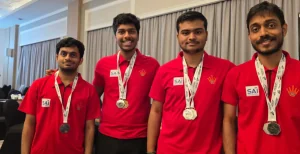
India earned the silver medal in the Open section of the Asian Nations Chess Cup 2026, which wrapped up on November 17 in Abu Dhabi, United Arab Emirates. The Indian team finished second to Russia after a closely contested nine-round event featuring top chess nations from Asia.
Details of the Asian Nations Chess Cup 2026
The tournament brought together elite chess teams competing over nine rounds in a team format. Russia emerged as the champions, securing the gold medal with 16 match points. India followed closely with 15 match points, achieving seven wins, one draw, and one loss. The only defeat India suffered was against Russia, the eventual winners.
India’s squad consisted of four grandmasters: Nihal Sarin, Pranav Venkatesh, Pranesh M, and Aravindh Chithambaram. Notably, the team competed without any reserve players, coaches, or official captains, relying solely on the core four players throughout the event.
Individual Achievements by Indian Players
Several Indian players earned individual medals for their outstanding performances on their respective boards. Aravindh Chithambaram won the gold medal on Board 4 by scoring 8 points out of 9 games, demonstrating remarkable consistency and skill. Pranesh M secured the silver medal on Board 3 with 7.5 points, while Pranav Venkatesh took bronze on Board 2, scoring 6 points.
These individual accolades highlight the depth of talent in the Indian team and their ability to perform strongly in a high-pressure international setting.
Context on Indian Chess and Tournament Structure
India has been steadily rising as a chess powerhouse, with players like Aravindh Chithambaram, who won the Indian Chess Championships in 2018 and 2019, and Nihal Sarin, who was crowned World Under-10 Champion in 2014. These achievements reflect the country’s growing prominence on the global chess stage.
Team chess tournaments like the Asian Nations Chess Cup use a scoring system that differentiates between board points and match points. Board points are the sum of individual game results, while match points are awarded based on the outcome of each team encounter. This system ensures that both individual and team performances are recognized.
Additionally, the International Chess Federation (FIDE) maintains separate rating lists for different time controls—standard, rapid, and blitz—meaning a player’s rating in one format does not directly affect their rating in another.
What India’s Silver Medal Means for Chess
India’s strong showing at the Asian Nations Chess Cup 2026 underscores the country’s emergence as a formidable force in international chess. Competing without reserves or a coach, the team’s resilience and individual brilliance were on full display. The silver medal not only boosts the confidence of the players but also inspires the next generation of Indian chess enthusiasts.
This performance may encourage greater investment and support for chess in India, helping to nurture talent and improve training infrastructure. It also signals to the global chess community that India is capable of challenging traditional powerhouses like Russia.
Frequently Asked Questions
Q: Who were the members of the Indian chess team at the Asian Nations Chess Cup 2026?
A: The Indian team consisted of Grandmasters Nihal Sarin, Pranav Venkatesh, Pranesh M, and Aravindh Chithambaram.
Q: How did India perform overall in the tournament?
A: India finished second in the Open section with 15 match points, achieving seven wins, one draw, and one loss in nine rounds.
Q: What individual medals did Indian players win?
A: Aravindh Chithambaram won gold on Board 4, Pranesh M earned silver on Board 3, and Pranav Venkatesh took bronze on Board 2.