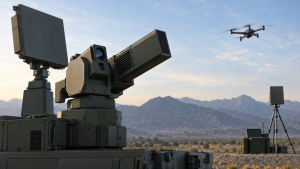
On November 23, 2026, India conducted a successful test of the JWALA MK-1, an indigenous autonomous counter-drone micro-missile system, at the Pokhran test range in Rajasthan. Developed by the Indian defence technology firm IG Defence, this system marks a significant advancement in the country’s ability to detect and neutralize hostile drones autonomously.
Understanding the JWALA MK-1 and Its Technology
The JWALA MK-1 is designed to operate within a range of up to 5 kilometres, targeting unmanned aerial vehicles (UAVs) that pose threats to security. It employs a dual-pulse solid rocket motor, which provides the propulsion needed for quick interception. The system integrates micro-missile technology with an artificial intelligence-powered mission management platform called GRID, which serves as the intelligence backbone. GRID oversees the entire process from detecting a threat to engaging it, enabling the system to function autonomously without human intervention.
Solid-propellant rockets like those used in JWALA MK-1 have the advantage of long-term storage stability, meaning they can be kept ready for extended periods without significant degradation. This reliability is crucial for military applications where readiness is essential.
Key Features and Operational Details
- Range: Effective up to 5 kilometres for detecting and neutralizing hostile drones.
- Propulsion: Utilizes a dual-pulse solid rocket motor for rapid response.
- Autonomy: The GRID AI platform manages threat detection, identification, and engagement sequences.
- Hard-kill capability: Physically destroys incoming drones rather than just disrupting their signals.
- Cost-effectiveness: Designed to counter inexpensive attack drones efficiently and complement existing air-defence systems.
Why JWALA MK-1 Matters for India’s Defence
The rise of drone technology has introduced new challenges for national security, as inexpensive and easily deployable drones can be used for surveillance or attacks. Traditional air-defence systems may not always be effective or economical against such small, agile threats. The JWALA MK-1 provides a dedicated solution by physically intercepting and destroying hostile drones, reducing the risk they pose.
By developing this system domestically, India strengthens its defence capabilities while reducing reliance on foreign technology. The autonomous nature of JWALA MK-1 allows for faster response times and reduces the burden on human operators during critical situations. This test represents a step forward in counter-drone technology, enhancing India’s preparedness against evolving aerial threats.
Frequently Asked Questions
Q: What is the operational range of the JWALA MK-1 system?
A: The JWALA MK-1 can detect and neutralize hostile drones within a range of up to 5 kilometres.
Q: How does the JWALA MK-1 destroy drones?
A: It uses a hard-kill approach by physically intercepting and destroying incoming drones with micro-missiles powered by a dual-pulse solid rocket motor.
Q: What role does artificial intelligence play in the JWALA MK-1?
A: The system’s AI platform, called GRID, manages the entire mission sequence from detecting threats to engaging them autonomously, enabling rapid and efficient counter-drone operations.