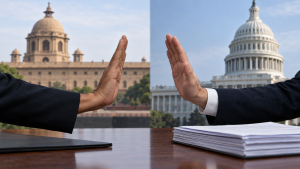
India has firmly rejected the United States Trade Representative's (USTR) recent finding that labeled India's industrial policies as causing structural excess capacity and unfairly burdening US commerce. On November 25, 2026, the USTR concluded that India's manufacturing and production policies, including flagship initiatives like Make in India, Atmanirbhar Bharat, and the Production Linked Incentive (PLI) schemes, contributed to excess capacity that distorted trade. India responded on November 26, stating it has no such excess capacity and has cooperated fully throughout the investigation.
The USTR's determination is part of a broader investigation launched on March 11, 2026, covering 16 economies worldwide. Out of these, 14 countries, including India, were found to have policies that the USTR deemed unreasonable and trade-distorting. As a result, the USTR has proposed tariffs of up to 25% on all goods imported from India, with the possibility of reducing the tariff to 17% if a mutually agreeable Resolution on Reciprocal Trade is reached.
India's Response to the USTR's Claims
India's Ministry of Commerce and Industry acknowledged the USTR's notice but emphasized that the claims of structural excess capacity were unfounded. Officials highlighted India's commitment to fair trade and pointed out that the PLI schemes reward companies only for incremental sales of products manufactured domestically, not for creating surplus capacity. The schemes are administered by the Department for Promotion of Industry and Internal Trade alongside relevant ministries, aiming to boost manufacturing competitiveness without distorting trade.
India also stressed that it has engaged constructively with the USTR throughout the investigation process and called for trade concerns to be resolved through ongoing bilateral trade agreement negotiations rather than unilateral tariffs. The government underscored the importance of dialogue and cooperation to resolve differences without disrupting the trade relationship.
Implications of Proposed Tariffs and Next Steps
The USTR's proposed tariffs could significantly impact bilateral trade, affecting a wide range of Indian exports to the US. The tariffs are intended to address what the USTR views as unfair trade practices linked to India's industrial policies. However, India maintains that these policies are designed to promote self-reliance and economic growth without harming foreign trade partners.
Public comments on the proposed tariffs are open until January 5, 2027, with hearings scheduled to begin on January 25. Both countries are expected to continue negotiations in hopes of reaching an agreement that could reduce or eliminate the proposed tariffs. The outcome will be closely watched by businesses and policymakers, as it will shape the future of the US-India trade relationship.
Understanding the USTR and India's PLI Schemes
The USTR operates within the Executive Office of the President of the United States and serves as a Cabinet-level adviser and negotiator on trade policy. It coordinates trade policy across government agencies through bodies like the Trade Policy Committee and the Trade Policy Staff Committee. The USTR's investigations and determinations carry significant weight in shaping US trade actions.
India's Production Linked Incentive (PLI) schemes are targeted programs that incentivize companies to increase domestic manufacturing by rewarding incremental sales growth. These schemes are part of India's broader strategy to enhance manufacturing capabilities and reduce dependence on imports, aligning with initiatives like Make in India and Atmanirbhar Bharat. The government insists that these policies comply with international trade rules and do not create unfair excess capacity.