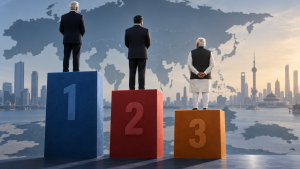
The Lowy Institute's Asia Power Index 2026 places India as the third most influential power in Asia, scoring 40.5 out of 100. The United States and China hold the top two positions, with China remaining significantly ahead despite India closing the gap. This ranking reflects India's growing diplomatic influence and regional engagement amid shifting economic and military dynamics.
Understanding the Asia Power Index
The Asia Power Index is an annual assessment conducted by the Lowy Institute, evaluating the power and influence of 27 countries and territories across Asia. It uses 131 indicators grouped into eight thematic categories, measuring both tangible resources and the ability to convert those resources into influence. The index divides its evaluation into two main components: resources and influence. Economic and military capabilities each account for 17.5% of the total score, while resilience and future resources contribute 10% each. Influence is measured through economic relationships (15%), and defence networks, diplomatic influence, and cultural influence (each 10%). This comprehensive approach provides a nuanced picture of power dynamics in the region.
India's Performance in Key Areas
- Diplomatic Influence: India scored 70.3 points, its strongest category. Prime Minister Narendra Modi was ranked the second-most effective regional leader, just behind Chinese President Xi Jinping.
- Future Resources: India improved its score to 56.2, indicating potential growth in capabilities and assets.
- Economic Capability: This score declined to 26.4, affected by a weakening rupee, changes in the International Monetary Fund's methodology, and a nearly US$20 billion drop in outbound investment.
- Economic Relationships: India maintained its position at seventh place, reflecting steady trade and investment ties.
- Defence Networks: Rising to 18.6 points and ninth place, India’s increased regional engagement and sales of BrahMos missiles to Southeast Asian countries contributed to this improvement.
- Cultural Influence: This also rose to 43.8, highlighting India's growing soft power in the region.
- Power Yield: For the first time since 2023, India narrowed the gap in Power Yield, which measures how effectively a country converts its resources into influence across Asia.
Shifts Among Regional Powers
The United States leads the index with a score of 78.9, followed by China at 73.6, marking the closest margin since the index began in 2018. The US's slight decline is partly attributed to foreign policy challenges, including ongoing tensions with Iran. Japan and Russia hold the fourth and fifth spots respectively, while Australia remains sixth. The index highlights the evolving balance of power in Asia, where economic, military, and diplomatic factors interplay amid global and regional developments.
Frequently Asked Questions
Q: What is the Asia Power Index?
A: It is an annual ranking by the Lowy Institute that measures the power and influence of countries in Asia based on economic, military, diplomatic, and cultural factors.
Q: How does India compare to China in this index?
A: India ranks third with a score of 40.5, while China is second with 73.6 points. Although China remains about 80% more powerful, India has narrowed the gap to its smallest since 2018.
Q: What contributed to India's rise in the index?
A: India's strong diplomatic influence, increased defence networks through missile sales, and improved cultural influence helped boost its ranking despite some economic challenges.